Information about New Earth
People Creating the New Earth
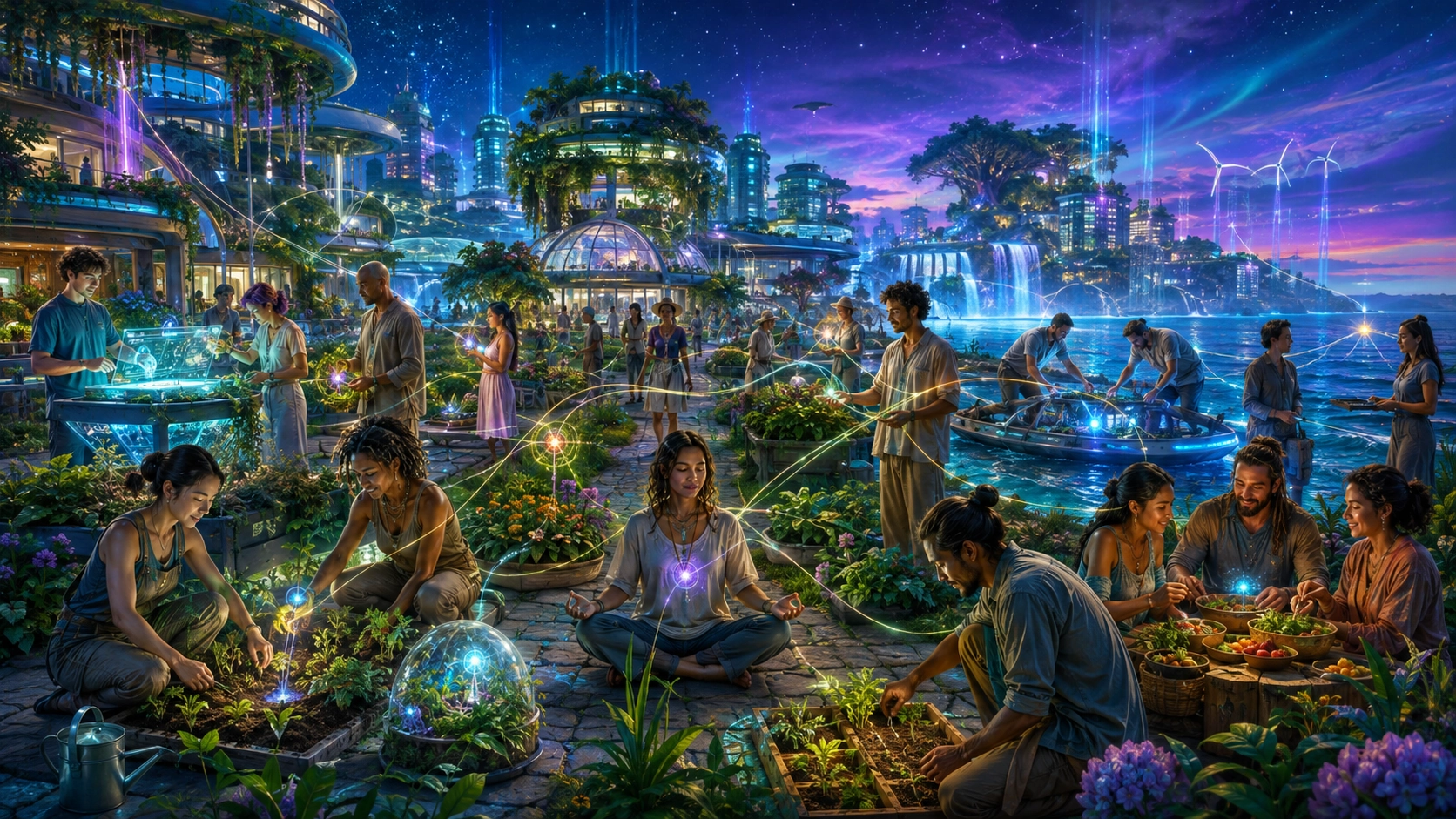
The New Earth is not a distant utopia or a ready-made programme that someone else is meant to introduce for us. It is a living process arising through the collective manifestation of a vast number of people. Every personal transformation, conscious choice and concrete action adds something to our shared direction. From the spiritual perspective of this project, we can speak of nourishing the egregore of the New Earth — a shared field of intention, values and energy that grows stronger as more people choose love, truth, responsibility, freedom and cooperation. This is the spiritual language of the project and one way of describing a collective process, not a concept that everyone must understand in the same way.
The New Earth has no single headquarters, organisation or closed list of members. It is being created by people who are expanding their awareness, healing their own lives, protecting nature, building new solutions, sharing knowledge and showing kindness to others. They do not have to know this term or agree with one another about everything. What connects them is their direction: moving away from a life based mainly on fear, control and competition, and creating a reality with more presence, responsibility and care for the whole.
The people below are simply recognisable examples. Each of them works in a different way, uses a different language and also inspires debate. We are not turning them into infallible authorities. We are looking at what they contribute, what may inspire us and what we can learn, while preserving our own discernment.
Joe Dispenza — Conscious Change and the Possibility of a New Life
For many people, Joe Dispenza has become a symbol of the belief that a person does not have to spend an entire lifetime repeating the same thoughts, emotions and behaviours. His work combines meditation, changing beliefs, working with emotional states and the language of neuroscience. His central message is that if we want to create a different future, we cannot endlessly remain the same version of ourselves. An inner transformation is needed: noticing old patterns, stepping beyond automatic reactions and regularly practising a new way of thinking, feeling and acting.
An important part of this approach is reversing the old order. In the old model, a person first waited for a result and only then expected to feel joy, gratitude, safety or abundance. Something was supposed to happen externally before they could allow themselves to enter a particular inner state. In conscious creation, the direction is reversed: we first learn to feel the emotions connected with our chosen future before its visible result appears. This is not about pretending or denying a difficult situation. It is about no longer making all our energy dependent on what already exists, and beginning to live inwardly in harmony with what we want to create.
A great many personal testimonies have grown around Dispenza’s workshops and meditations. People speak about profound emotional changes, release from past trauma, improved relationships, the courage to change jobs, greater abundance and a sense that they have regained influence over their own lives. Some also report improvements in health, relief from chronic pain, migraines or allergies, while certain testimonies describe remissions and changes that participants understand as healing. For these people, these are not abstract theories but real experiences that changed their lives. There is no reason to dismiss them simply because science cannot yet explain every individual case in the same way.
At the same time, one person’s testimony is not a guarantee of the same result for everyone. Health depends on many factors, and meditation should not be presented as an automatic substitute for diagnosis or necessary treatment. We can respectfully leave room both for the experiences of people who feel that manifestation and meditation genuinely helped them and for honest questions about what has been studied so far.
Studies have now been published on changes accompanying workshops and meditations conducted in this environment. A 2025 pilot study of twins described changes in gene expression, metabolites and cytokines, as well as correlations in brain activity between twins meditating in separate rooms. It was a small, exploratory study and was not preregistered, so its findings should be treated as the beginning of further questions rather than conclusive proof.
Another 2025 study observed twenty healthy participants during a seven-day, multi-component retreat. Researchers recorded short-term changes in the functioning of certain brain networks, including the default mode network and the salience network, as well as changes in plasma that was later examined under laboratory conditions. Because the programme combined many practices at once, it is not easy to attribute all the changes to a single element. A 2020 study of two hundred and twenty-three beginner meditators observed changes in recorded brainwaves after a three-day workshop. A broader review of research into meditation retreats also indicated moderate benefits, although substantial differences between studies limited the strength of the conclusions.
Joe Dispenza co-authored some of these publications and is professionally connected with the company organising the workshops. This affiliation is important information and strengthens the need for independent replication. It does not, however, automatically invalidate the observations themselves. An honest approach means seeing the potential, participants’ experiences, the findings to date and their limitations at the same time. It is within this open space that further understanding can develop.
Eckhart Tolle — Presence and Moving Beyond the Ego
What Eckhart Tolle brings to the vision of the New Earth above all is stillness, presence and the recognition that a person is not merely the stream of their own thoughts. His teaching focuses on the present moment and on gradually moving beyond identification with the ego. According to Tolle, a large part of unnecessary suffering arises when we unconsciously believe every thought, defend a constructed image of ourselves and need conflict to maintain our identity.
The book A New Earth: Awakening to Your Life’s Purpose helped bring this idea into a global conversation. Tolle does not present the New Earth as an external institution. It begins as a shift in consciousness within an individual and then influences their relationships and actions. When we can notice our own reaction before it turns into an attack, compulsion or judgement, space appears for a different choice.
Tolle also draws attention to the collective ego. A group can reinforce its own identity by creating an enemy and emphasising another person’s difference. The New Earth will therefore not arise by replacing one war with another or by declaring ourselves spiritually superior to others. It awakens wherever justice, acceptance and care for people, animals and the planet grow. In his view, a crisis does not have to be only an ending. It can reveal the ineffectiveness of an existing way of life and become an impulse for the evolution of consciousness.
Vandana Shiva — Biodiversity, Seeds and Local Communities
Vandana Shiva shows that awareness of the New Earth must meet the physical earth, water, food and the everyday life of local communities. This Indian physicist, writer and activist received the Right Livelihood Award in 1993. She founded the Navdanya movement, which works to protect native seeds, biodiversity, ecological farming and the rights of small-scale farmers.
From her perspective, a seed is not merely a commodity. It is part of a shared heritage, local knowledge and a community’s ability to produce its own food. Shiva opposes the patenting of traditional knowledge and the excessive concentration of control over agriculture in the hands of large corporations. Navdanya’s activities include creating seed banks, training farmers and preserving local plant varieties.
Not all of Shiva’s claims about industrial agriculture, genetically modified organisms and the consequences of the Green Revolution are universally accepted. Her assessments are the subject of serious scientific and economic debate. Instead of turning this difference into a simple fight between two camps, we can treat it as a reminder that every technology should be evaluated not only by its short-term efficiency, but also by its impact on ecosystems, farmers’ independence, biodiversity and the safety of future generations.
Boyan Slat — Technology, Persistence and Cleaning the Oceans
Boyan Slat represents a different kind of agency. As a teenager diving in Greece, he saw an enormous amount of plastic in the water and began wondering how it could be removed on a large scale. That question gave rise to The Ocean Cleanup, an organisation whose stated goal is to remove ninety per cent of floating ocean plastic by 2040.
The organisation develops two areas of activity: removing accumulated plastic from the Great Pacific Garbage Patch and trying to intercept waste in rivers before it reaches the seas. It is an example of creating a solution through successive prototypes, tests, failures and improvements. Not all the early ideas worked as expected. The team therefore changed the systems’ design and learned from the data instead of abandoning the goal after the first difficulties.
According to the organisation’s own report, in 2024 it removed more than one hundred and forty thousand kilograms of plastic from the Great Pacific Garbage Patch and more than eleven million kilograms of waste from rivers. These are the organisation’s figures and should be understood as such. The Ocean Cleanup is also looking for ways to use recovered material in new products.
The project faces high operating costs and questions about the impact of large collection systems on marine life. The organisation conducts environmental impact assessments and develops safeguards, including a special hatch that allows animals to leave the waste retention zone. This example shows that technology serving the New Earth should not rest on blind faith in an invention. It requires impact monitoring, corrections, responsibility and a willingness to learn.
Nipun Mehta — Gift Economy and Heart-Based Activism
Nipun Mehta shows that social transformation can begin with a very small gesture. After working as a software engineer in Silicon Valley, he co-founded ServiceSpace, a global community of projects based on volunteering, selfless service and the gift economy. Instead of building relationships solely as an exchange — I give something to you in order to receive something in return — ServiceSpace creates a space in which the kindness we receive can be passed on to someone else.
Mehta speaks of heart-based activism. Its meaning lies not in grand declarations but in the quality of relationships and in the inner transformation of the person serving another human being. A small act of kindness can move both the recipient and the person performing it, and then set further gestures in motion. In this way, goodness does not remain a single transaction but begins to circulate through a community.
Mehta was honoured as an Unsung Hero of Compassion and served on the United States President’s Advisory Council on Faith-based and Neighborhood Partnerships. He brought to it the belief that social support should not be merely an impersonal procedure. It can create genuine human-to-human contact, rebuild trust and recognise different forms of wealth: not only money, but also relationships, knowledge, experience, culture, spirituality and the resources of nature.
We All Create One Field
Joe Dispenza, Eckhart Tolle, Vandana Shiva, Boyan Slat and Nipun Mehta represent very different paths. One focuses on meditation and conscious change, another on presence, another person on protecting the earth and seeds, the next on ocean-cleaning technology, and yet another on the gift economy and relationships. They do not belong to a single organisation and would probably disagree with one another on many issues. That is precisely why they are good examples. They show that the New Earth has no single compulsory form.
Well-known names can serve as points of reference. We can draw on their books, research, practices, projects and experiences while preserving our own discernment. We do not place anyone on a pedestal. Recognition, profession, wealth, academic title or number of followers does not determine a person’s value. Every person has the same inalienable worth.
There is a vast number of New Earth people, and more are emerging every day. They include public figures, but also people whose names we will never see in the media: a farmer protecting seeds, an engineer looking for clean technology, a doctor treating a patient with care, a teacher recognising a child’s potential, an entrepreneur building an honest business, a parent creating a safe home, a person helping a neighbour, and someone courageously healing their own life.
In truth, anyone can be a New Earth person when they awaken and consciously nourish its egregore. They need no permission, certificate or membership of a chosen group. It is enough that in their everyday choices they are increasingly guided by love instead of fear, truth instead of illusion, responsibility instead of helplessness, and cooperation instead of the need to dominate.
This does not mean perfection. A New Earth person may make mistakes, experience difficult emotions, change their mind and begin again. Awakening is not a status that elevates some people above others. It is a process of remembering who we want to be and bringing that remembrance into life with growing awareness.
Every moment of presence, every act of respect, every calmly expressed boundary, every creative idea and every action serving life adds energy to the shared field. This is where personal manifestation meets collective manifestation. By changing ourselves and our immediate surroundings, we do not act in isolation. Together, we give shape to a reality that previously existed only as a possibility.
No one will create the New Earth for us. At the same time, no one has to create it alone. It is already arising — in the awareness, relationships, projects and everyday decisions of a vast number of people. Each of us is an important part of this process. Together, we are all creating the New Earth.