Information about New Earth
Two Timelines and Two Egregores
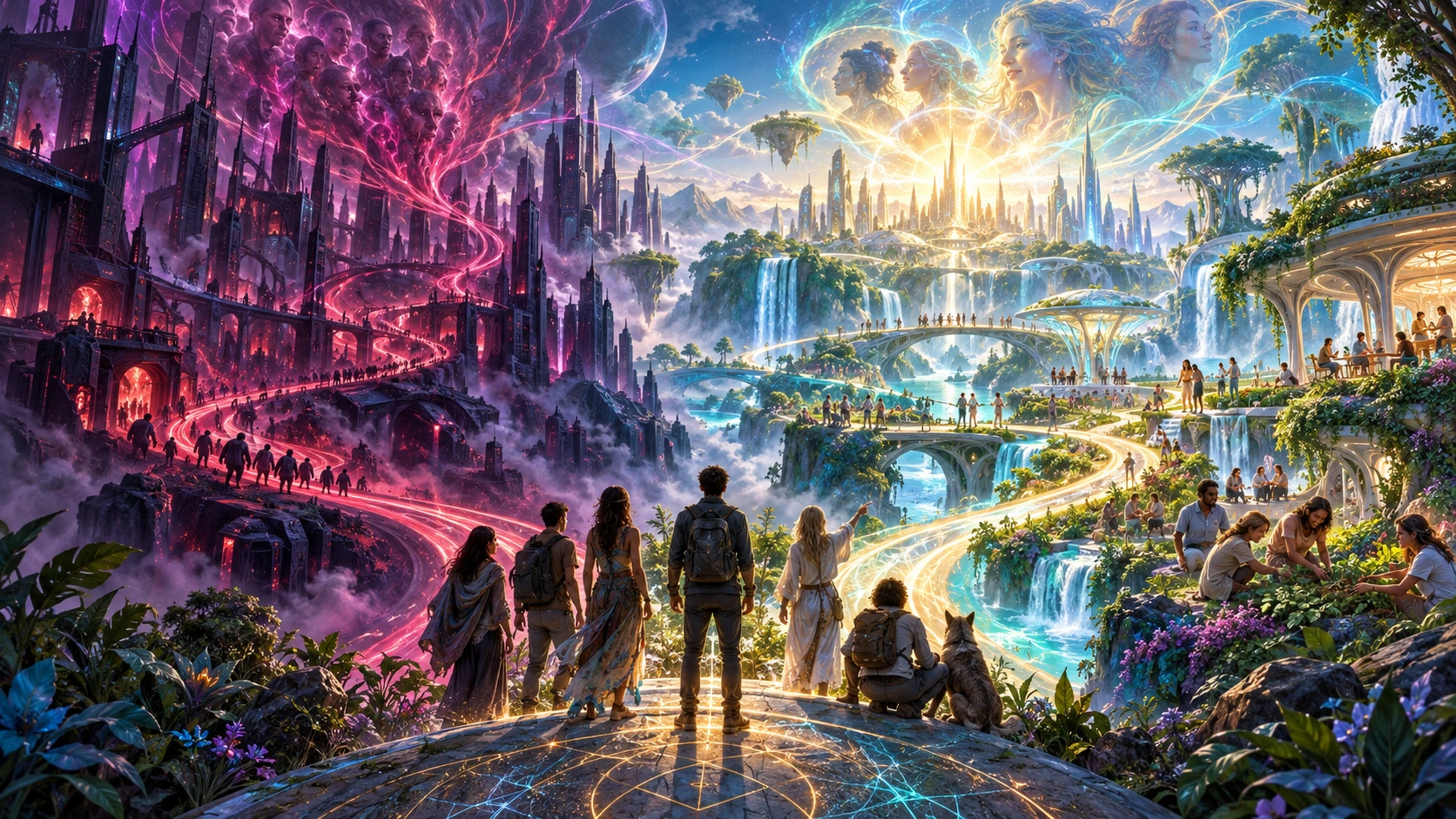
I look at the world and see two directions developing alongside each other. In one, people grow increasingly afraid of the future, lose trust and try to control one another. In the other, they learn to understand themselves, regain their sense of self-worth and create something that serves life.
In my spiritual vision, these are two timelines. Each has an egregore — a shared space of thoughts, emotions, intentions and actions. I call the second direction the New Earth. This is the language I use to describe my own understanding of how people and the world can change. You can explore this vision and see what resonates with you.
What interests me most is how we can consciously develop the direction we choose. What do we do with our time? How do we treat people? What stories do we tell? What do we create when anger settles and we have room to make our own decision again?
Two Directions for the Future
Imagine two conversations. In the first, everyone adds another prediction of disaster. Someone says people are hopeless. Someone else says everything has already been decided. The search for someone to blame begins. An hour later, the participants feel more tense, but they still do not know what they can do with their lives.
In the second conversation, difficulties also come up. People name them directly, then ask: what can we change? Who needs support? What options do we have? One person suggests an action, another brings a skill, a third speaks honestly about their limits. Something emerges that they can start with.
This is how I understand the two directions. I recognise them in conversations, work, culture and my own reactions. In my vision, a timeline means the future we move towards through successive choices. Our contribution intertwines with other people's actions and with circumstances we can influence to different degrees.
That is why I prefer to think of the future as a space we shape together. I can influence part of that space. I can decide how I respond to someone, how I use my skills and what I devote my energy to. That is where my contribution begins.
What I Call an Egregore
For me, an egregore is a name for a shared space that people feed with thoughts, emotions, intentions and actions. Spiritually, I understand it as the shared energy of a particular direction. In everyday life, I see its reflection in a group's atmosphere, recurring stories and behaviours that people reinforce in one another.
A group may keep returning to putting others down. It may also develop a habit of listening, learning and helping. Each new conversation is an opportunity to add something to this shared way of being. Over time, certain words and reactions become familiar in that environment.
That is why I ask what I am feeding with my attention. What content do I repeat? What conversations do I return to? What do I bring into the shared space when I am tired or irritated myself?
Here, egregores and the two timelines remain the language of my spiritual vision. Describing a group's atmosphere helps explain that vision, but does not in itself prove the existence of a metaphysical mechanism. We can talk about spirituality and remain honest about what we know and what we interpret.
How I Recognise the Old Direction
I associate the old direction with living in constant tension. You have to win every conversation, prove your worth, find someone worse than yourself or acquire something that is finally supposed to bring peace. Increasingly, you see other people through the lens of threats, advantages and comparisons.
In this way of living, it is easy to lose sight of your own purpose. In the morning, I wanted to do something important. Then came a provocation, a piece of content predicting catastrophe, another argument. By evening, I am exhausted. My attention has been occupied, while the project, conversation or necessary decision still waits.
I also recognise the old direction wherever a person is treated as a tool: they are expected to work, buy, obey and ask no questions. Their worth is supposed to depend on money, status or usefulness to someone else. In my vision of the New Earth, human dignity is the starting point.
Any of us can recognise such reactions in ourselves, too. It helps to look at the specific situation. What triggered me? What am I doing now? Does this action help resolve the issue, or does it only prolong my tension? That moment of honesty makes another choice possible.
What the Egregore of the New Earth Looks Like
I see the New Earth as a space where people regain their agency and learn to live with greater awareness. They know their worth, can say what they need and respect another person's boundaries. They develop, create, share knowledge and build relationships that give them room to breathe.
For me, empathy means trying to understand a person. What does the situation look like from their perspective? What might they be experiencing? What am I missing when I look only from where I stand? Questions like these can open a conversation. At the same time, everyone is responsible for their own behaviour and has the right to protect their own space.
I see self-love in ordinary decisions. I allow myself to rest. I respect my work. I admit a mistake and look for a way to put it right. I notice my own needs and take them seriously. My worth stays with me even when something has gone wrong.
Responsibility gives this vision a practical form. If I have promised something, I make sure it happens or honestly say that I need to change our agreement. If I have hurt someone, I can acknowledge it. If I see a problem, I consider what I can actually contribute to solving it.
In this New Earth, technology helps us create, discover the world and make life easier. Knowledge becomes more accessible. Cooperation brings different skills together. There is room for curiosity, pleasure, humour, beauty and rest. I want a world where growth also includes joy.
Films and Games That Help Shape the New Earth
The New Earth should also have its own films and games. This is an important part of my vision. The stories we create show who a hero can be, what deserves admiration and what kind of ending we consider a victory.
I call the glorification of cruelty, humiliation and killing pathological. I am particularly troubled by entertainment that makes harming others its main reward and repeats the same way of gaining an advantage. In my spiritual interpretation, such content can feed a negative egregore. That is how I judge this direction in culture.
I want more films full of learning about empathy, responsibility and self-love. I see them as engaging stories, with adventure, emotion and characters whose choices matter. A person can learn to tell the truth, recognise their needs, repair harm and understand someone who thinks differently.
I imagine a film in which the main character makes a mistake, faces the consequences and gradually learns responsibility. Their strength grows with their ability to acknowledge what they have done. Another story could show someone regaining self-respect and building a life in line with their values. Such stories have room for tension, loss, courage and transformation.
New Earth games can offer satisfaction through developing skills: cooperation, ingenuity, planning, communication and care for a shared space. I would like gameplay in which we build, discover and look for solutions. The game world can respond to the quality of our decisions and our relationships with other characters.
We could rebuild a city, bring life back to a damaged place or save an endangered ecosystem. We could lead an expedition together, divide up tasks and draw on the team's different abilities. We could learn about residents' needs, resolve disputes and create inventions. Challenge, pace and adventure all have a place in such a game.
I would like the player's involvement to lead to questions: what can I create? How will I help the team? What consequences will my decision have? For me, this kind of game design is a concrete way to develop the culture of the New Earth.
Assessing the influence of media on people requires care. Research gives us reasons to explore whether some games can support helping behaviour and selected films can encourage reflection. However, findings depend on the content, conditions and what was measured. Watching a story does not guarantee lasting change, and playing fictional games containing violence does not determine whether a person is aggressive. My criticism concerns, above all, the values I want to support and develop.
After a film, we can talk about a character's decisions. After a game, we can notice how we cooperated. The experience then becomes a starting point for our own reflection. I am particularly interested in what we bring from that reflection into everyday life.
Reclaiming My Attention, Reclaiming My Direction
Sometimes I lose faith in what I am doing. I feel tired or frustrated, or feel that another attempt will change nothing. I know that moment when it is hard to see the value of my own work. Finding calm and the next step matters to me.
A question helps me: what do I really want to focus on now? Sometimes the answer is solving a technical problem. Sometimes it is a necessary conversation. At other times, it is rest, so I can return with greater clarity. I can change my method, reduce the number of things I am dealing with or complete a small part of a larger task.
As I understand it, this is where the choice of direction happens. I notice my own state and reclaim room to decide. I allow the emotion, then choose an action that is possible at that moment.
Fear, anger and sadness are part of human life. A difficult day still leaves room for the New Earth. Sometimes its first sign is calmly taking care of yourself. Sometimes it is refusing to continue a conversation that hurts. Sometimes it is returning to something I previously considered worthless and giving myself another try.
Choosing the New Earth in an Ordinary Day
Someone pressures me to do something against my wishes. I pause and clearly say what I agree to. I can be kind and maintain a boundary. This is what freedom combined with responsibility for my own involvement looks like.
A conflict arises. I check what actually happened and what I need. I choose a conversation, a specific protective action or ending the contact. When real harm is involved, evidence, support and reporting a threat may be necessary. Building peace includes protecting people.
I choose a film or game. I look at what draws me in, what is rewarded and what stays with me afterwards. I also seek content that inspires curiosity, respect, the joy of creating or a desire to understand another person. Through my attention, I can support creators whose direction feels close to my own.
I make a decision about a purchase or work. I consider my needs, possibilities and the value of what I do. I can keep using things that still serve me well and appreciate my skills. A person's worth goes beyond their income or possessions.
I return to a project. I choose one task I can complete. I save a page, learn a tool, fix an error or create part of a story. Something real comes into being. It is my small contribution to the direction I want to develop.
We Can Change Direction
In my vision, a person can change direction many times. They may notice their own reaction only after a conversation. They can return, apologise, correct a decision or pause earlier next time. Growth includes such attempts.
I am learning this myself. It is easy to talk about awareness when everything is calm. It is harder to remember it when tired, disappointed or in conflict. That is why I value returning to my own values after a difficult moment. One mistake need not define the rest of a life.
The two timelines help me question the direction of my actions. Every person retains their dignity, regardless of how close my views are to theirs. We can differ and still talk with respect. We can also clearly judge specific actions and protect our boundaries.
There are situations where violence, living conditions or other people's actions limit the choices available. A person who has been harmed deserves support. My vision provides no grounds for blaming them for someone else's violence or for the mere fact of their suffering. Creating a better world together also includes changing conditions that harm people.
What Am I Adding to Our Shared Future Today?
You can pause for a moment and look at your day. What took up most of your attention? What conversations did you keep going? What did you create? Which decision was in line with the way you want to live?
Choose one action for tomorrow. A calm conversation. A clear boundary. A moment of rest. Returning to your own project. A game together in which we learn to help. A film followed by room for a conversation about a person. Something small that has real meaning for you.
In my vision, this is how we develop the egregore of the New Earth: through an intention expressed in our way of living. Through how we treat ourselves, what we create and how we relate to others. Everyone can add their own part.
What did I strengthen with my attention today? Which of my actions served the world I want to live in? What will I choose more consciously tomorrow?
The New Earth takes shape when our intentions become actions.