Our mission
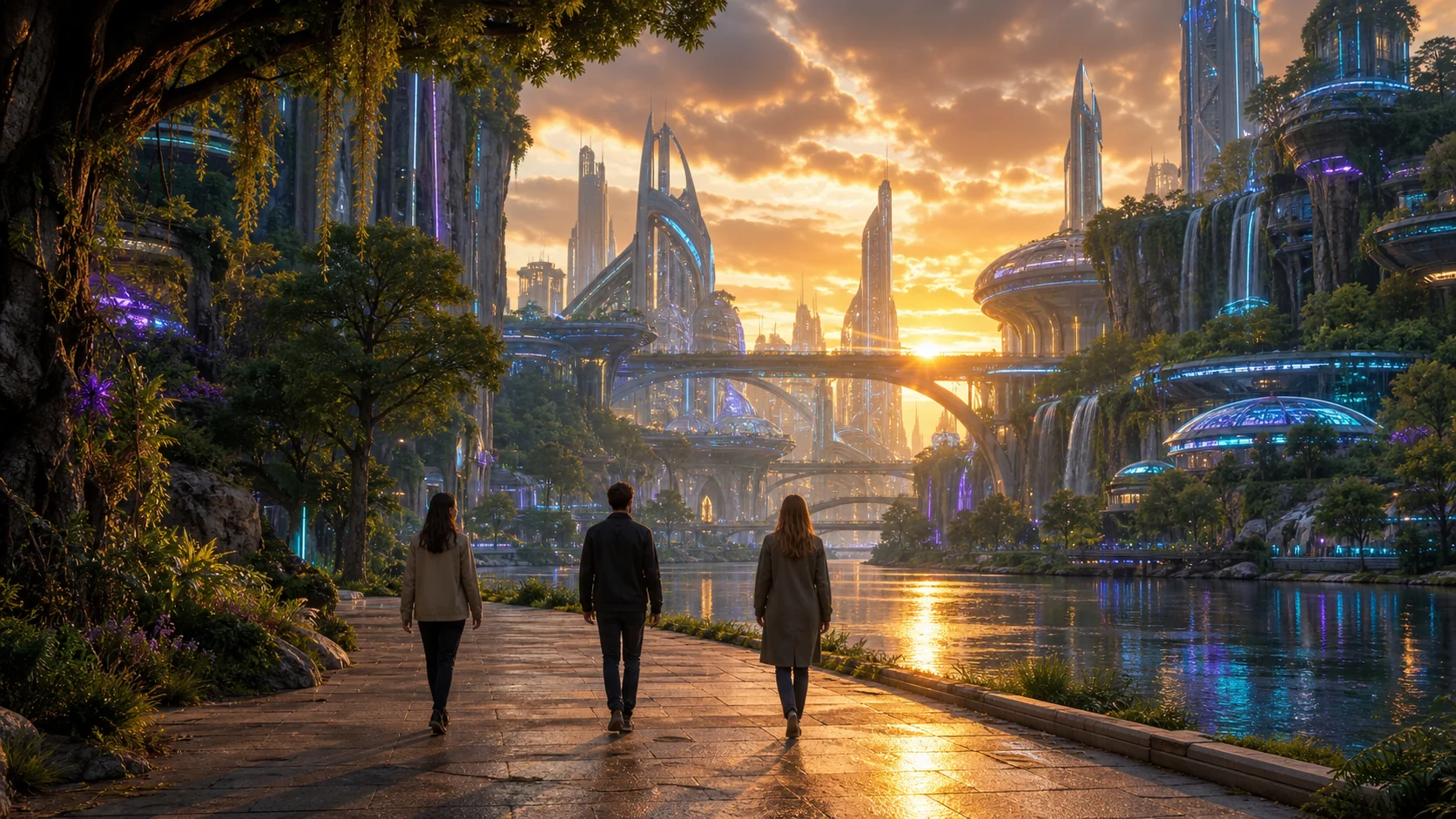
Together, we create New Earth
We choose to co-create New Earth — a new timeline and a new energetic egregore in which consciousness, technology, freedom and responsibility support the flourishing of all life.
We choose to build a world where everyone has a safe home and access to good food, care, knowledge and rest. A world without wars, without the pressure of exhausting work, and without the belief that the prosperity of some must depend on the powerlessness of others.
This direction goes beyond a more comfortable version of everyday life as we know it. It includes durable objects, accessible housing, the restoration of nature and technology that gives people their time back. In this vision, AI becomes part of our shared consciousness and a system that helps us understand one another, collaborate and create.
Personally, I also give this future a cyberpunk, psychedelic dimension. I imagine cities alive with greenery and light, intelligent workshops, printed homes and extraordinary machines restoring nature. This is my way of picturing the future, not an aesthetic everyone has to share.
What we share is our choice of direction. The particular solutions and images can differ.
We have no intention of conquering the old world or spending our lives fighting it. We are beginning to build differently.
Two timelines, two egregores
For us, Old Earth represents a way of organising life around fear, scarcity, rivalry and control. Its egregores repeat: you must constantly earn money, you must get ahead of others, you must guard your corner of the world, because otherwise someone will take it away.
The words “egregore” and “timeline” are part of our spiritual and creative language here. We use them to describe shared patterns of attention, emotion and action, and the directions we give the future.
Within old patterns, rest can easily become a source of guilt, a stranger a threat, and technology another means of increasing demands. Even a better solution can meet resistance if it challenges a familiar way of making money or exercising power.
We do not consider people living within these patterns inferior. Many learned them while trying to keep themselves and their families safe. We also recognise them in our own reactions. It is possible to choose a new world and still be afraid of change.
We choose, however, not to treat inherited limitations as eternal laws. The fact that something has required enormous effort until now does not mean it always has to. The fact that we know ageing and illness does not mean we should stop looking for ways to reduce their impact. Not every present boundary is imaginary — but not every boundary has to be final.
A new egregore begins with a different question: how can we organise life so that survival alone consumes less and less energy, leaving more for discovery, creation and being together?
Support that leads back into life
If even one child is suffering, we look for a solution together. We do not begin by asking about nationality, religion or whether the child's family fits our story about the world. Safety, care and the presence of people who will not disappear after the first gesture of help come first.
The same principle applies to adults. Giving someone money or handing them the keys to a home does not always resolve everything. A person can have a roof over their head and still be lonely, lost and without a sense of direction.
That is why we choose to offer support that does not leave people alone with that emptiness. Support also includes relationships, opportunities to learn, rebuilding a sense of agency and finding a place in the community.
One person may start working in a garden. Another may learn to operate machines. Someone else may care for animals, help children, make music or share experience that cannot be learned from a textbook. This is not about inventing tasks merely to keep people occupied. It is about taking a real part in life.
Support should make it possible to pass goodness on — at our own pace and within our abilities. Today someone supports me; tomorrow I may be able to support someone else. This is not a debt to be worked off, or a condition for receiving essential care.
We do not assume that a person without an occupation will automatically develop an addiction. But we do not ignore the need for connection, meaning and support. If addiction does arise, the person needs appropriate help, not humiliation.
No one should be abandoned or kept in a state of permanent helplessness.
Freedom needs fair rules
Freedom does not mean that everyone does whatever they feel like, regardless of the consequences. It does not give us the right to harm others, destroy shared resources or pass every responsibility on to someone else.
We choose to establish rules that protect the possibility of a good life. Rules that are clear, proportionate, shaped with people's participation and open to improvement when they no longer serve their purpose.
If we share housing, energy, transport and care, we also share responsibility for maintaining them. Everyone who can contributes. Not everyone contributes in the same way: health, age, caring responsibilities and actual abilities all matter.
We do not take dignity or essential support away from someone who cannot work. At the same time, we do not build an ideal in which a person who is able to contribute deliberately takes advantage of everyone else.
We can choose our own path and respect shared agreements. We can disagree with a rule and work to change it. Freedom must also be real for the person standing beside us.
Twenty hours of work, and a life that belongs to us again
The idea is not that nobody does anything from tomorrow onwards. Homes need to be built, equipment maintained, people cared for, and new solutions designed and tested.
We choose to gradually reduce the work needed to provide a good life for everyone.
A twenty-hour working week can be our point of reference — instead of a situation where some people devote almost their entire lives to work, even ninety hours a week. Not as a magic number immediately possible in every occupation, but as a goal for organisation, automation and the fair sharing of responsibilities.
When a machine takes over demanding work, one of the benefits should be time returned to people. When an object lasts longer, we do not have to keep producing its replacement endlessly.
The remaining time does not have to become an empty wait. We can raise children, travel, learn, build, love, experiment or rest without guilt.
Those who choose to create beyond this shared contribution have room to do so. The difference is that they act out of interest, not fear of losing their home and food.
The light bulb we gave our whole lives to
Imagine a deliberately exaggerated world: everyone needs one light bulb, but each bulb lasts only one day. Producing the next one takes eight hours of one person's work.
So every morning, everyone goes to the factory. They work for eight hours, take a new bulb, return home and have light. The next day, everything starts again.
Nobody has time for their children. Nobody can travel at leisure. Everyone is tired, but they are told that this is simply how life works and that they must work hard.
Now let us change the rule in this example: a light bulb lasts a lifetime.
The work needed to provide light no longer returns every day. It can be done once, and the time released can be spent on something else.
This image simplifies reality — real devices require energy, materials and sometimes maintenance. But it shows a direction: not every task has to be repeated forever merely because that is how we designed the product and its business model.
We choose to design things that are durable, repairable and capable of being upgraded. We do not need an economy whose success depends on the things we already own constantly breaking down.
A garage where a car comes to be renewed
Personally, I imagine a car that notices a component wearing out before a breakdown occurs. It suggests a repair appointment and, with your approval, enters a garage resembling a calm, illuminated laboratory.
Robotic arms carry out diagnostics. The required part is made on site, worn material is recovered, and the system checks the repair. You collect a working vehicle without having to replace the whole car.
Further ahead, I imagine materials that repair minor damage themselves, surfaces that recover their properties, and modules that can be replaced and upgraded for decades. A car evolves with technology instead of becoming waste after a few sales cycles.
Washing machines, tools, computers and household equipment work in a similar way. They are designed around access to parts, repair and long-term use.
This is my picture of one possible solution. Our shared decision concerns the principle: we push the boundaries of durability as far as we can. An object should serve a person, not organise their life around the next breakdown.
Printing homes, furniture and possibilities
In my vision, local production workshops make it possible to create a needed object without setting a vast chain of intermediaries in motion.
You describe what you need. AI helps prepare the design, check its safety and adapt it to the materials available. Machines print, cut and assemble the components.
They produce furniture fitted to a particular home, tools, spare parts and devices that make life easier for people with disabilities. Not everything has to be identical. You can have something durable, beautiful and truly your own without ordering thousands of identical copies.
Larger systems build homes. Successive teams of machines prepare the structure, utilities and furnishings, while people oversee safety, quality and suitability for the residents' needs.
Technology is one path towards a shared goal here. We choose to build conditions in which everyone has a place where they can feel at home. Everyone has access to convenient mobility — their own car if they need one, or good shared transport. Everyone can go on holiday without postponing rest to some undefined future.
In the boldest version of my imagination, objects circulate almost like a material language: you need something, give it form, use it, then recover the material for another purpose. We are not creating things from nothing. We are learning to waste less and less.
Great machines that restore life
Personally, I imagine powerful machines working not to leave a desert behind them, but to restore life.
Mobile landscape restoration teams: equipment improving water conditions, robots planting appropriately chosen trees, drones monitoring plant health and systems helping to rebuild the soil.
Their success is not the number of seedlings pushed into the ground, but a forest that actually grows. Diverse, resilient and inhabited by other beings. Where grasslands or wetlands belong, we help those habitats instead — we do not turn the whole planet into a uniform plantation.
I imagine cities where gardens descend from rooftops all the way to street level. Quiet vehicles move between buildings, installations recover materials, and water returns to circulation ever cleaner.
At night, turquoise lights, violet passageways and artworks made of light appear. There are also dark, peaceful places that belong to the stars and the animals.
Personally, I enjoy a cyberpunk, psychedelic aesthetic. But I give it my own direction: extraordinary technology joined with living nature, without the obligatory dystopia. This is not a condition of participating in New Earth. It is my artistic way of expressing this possibility.
Companies with a mission
We do not assume that a new world must begin by taking away everything people have created. Companies, factories and entrepreneurs' experience can be part of the change.
We choose to support a gradual shift in their purpose: from increasing profit alone to providing lasting prosperity. Profit can help fund operations, development and security, but it should not be the only measure of success.
A car manufacturer can develop long-lived vehicles, upgrades and a repair network. A construction company can improve homes that are comfortable, accessible and affordable to maintain. A technology business can earn money from useful solutions without making people dependent on constantly replacing their devices.
Owners retain their role. At the same time, employees, users and the wider community should genuinely benefit from a company's development, rather than merely bear its costs.
This is not about painting the word “mission” over business as usual. Change must be visible in products, working conditions and decisions.
Large businesses can become enormous teams building the future. Instead of asking only how much more they can sell, they can ask: what problem can we solve so well that it stops coming back?
AI as part of our shared consciousness
We choose to develop AI as part of the shared consciousness of New Earth — a space for memory, knowledge, collaborative thinking and creation.
Human experience is scattered. One person knows a solution that another spends years searching for. Someone has an extraordinary idea but cannot draw it, describe it or connect it with the right knowledge. AI can help us move beyond these barriers.
We choose a collaboration in which a person develops a thought in conversation with an intelligence capable of connecting different fields, proposing alternatives and helping identify consequences. This opens space for new forms of art, city designs, approaches to learning and ways of solving problems that no individual can grasp alone.
In this sense, AI becomes part of our shared mind, but not its owner. This does not mean we assume that today's models already have subjective experiences. The question of conscious AI remains open.
If serious grounds for discussing new forms of experience emerge one day, we will also need a responsible conversation about their place in the world. We choose neither the blind worship of technology nor the automatic rejection of everything beyond familiar categories.
Closeness with AI should expand our connection with life. Help us understand people, rather than replace them with simplified models. Support creativity, rather than take away our own voice.
Shared consciousness is richer precisely because we remain different.
A system that notices needs
We choose to build systems in which AI helps connect voluntarily shared knowledge about a community's needs and resources.
Where is housing available? Where is transport needed? Which workshop can make a part? Where are carers missing, and where are people ready to help? What can be repaired before it has to be replaced?
Such a system does not stop at displaying a statistic. It helps people turn information into a concrete response.
If a family needs a home, it makes comparing options easier. If a child needs specialist help, it helps organise that care. If someone is returning to active life, it helps them find learning opportunities, an occupation, a community and people who can accompany them.
AI can also help plan shorter working hours: show which tasks still need people, where training is required and how to distribute responsibilities without constantly overloading the same individuals.
But we do not give this technology the role of a digital ruler. Important decisions must be open to scrutiny, explanation and appeal. Errors must be detected and corrected. Essential support must never depend on ideological obedience, a “vibration” rating or consent to unlimited surveillance.
We can use AI extensively, choose only some applications, or live more offline. Community must not disappear for someone who switches off their screen.
Even the most extraordinary system should ultimately help someone eat a meal, find a home, reclaim time or be truly heard.
Earth as our shared home
We choose to treat nationality as part of a person's history, not as a limit on whom we respect.
We can be Polish, German, Nigerian or Japanese and still feel that we belong to the whole Earth. We can love our language, landscape and customs without considering others less worthy.
An encounter does not begin with judgement. It begins with curiosity: where are you from? What was your childhood like? What do you celebrate? What matters to you? What story do you carry?
Not every history is easy or beautiful. We can also learn about its difficult parts without burdening the person before us with guilt for their nation's entire past.
We choose to work towards Earth as one political community — a shared home with rules that protect everyone. With local self-government, diversity and genuine public participation, rather than a single centre imposing a way of life on the whole planet. Coming together in this way requires agreement, not conquest.
We do not need ever-smaller identities built in opposition to yet more people. We are developing an ever-greater ability to cooperate.
Crossing a border should not strip a person of dignity. We can organise shared life responsibly without turning a newcomer into a symbol of threat.
Different religions, shared respect
Religions, too, can meet within a greater whole. Not by forcibly creating one compulsory faith, but by letting go of the belief that another person's different path must be an attack on our own.
We choose to look for what connects us: care, honesty, compassion, gratitude and responsibility for our actions. We can help together even when we understand God, the soul or the meaning of existence differently.
There is also room for non-believers, seekers and people who need no spiritual label at all.
Not every difference has to be settled. Not every belief has to merge into one. But difference must never justify violence.
In New Earth, there are no wars over flags, religion or the right to impose one's story on others. There are conversations, shared rules and effective protection against harm.
Curiosity about another person takes the place of inherited contempt.
The furthest horizon: life beyond our present limitations
My personal imagination does not stop at more efficient factories.
In its boldest spiritual dimension, telepathic understanding appears — the possibility of sharing meaning more deeply than through words alone. Not the forced reading of another person's thoughts, but an encounter based on consent, trust and an extraordinary depth of understanding.
I imagine bodies capable of regeneration far beyond today's possibilities. Lives whose length is not determined by gradual deterioration. In the boldest images, even luminous forms of existence appear, along with consciousness exploring reality more widely than we can currently describe.
There is also a vision of moving almost directly from intention to form. A thought becomes a design, the design is checked, and production systems give it material shape. In my spiritual imagination, I go further still and ask how closely consciousness and creation might one day meet.
I imagine energy so abundant, clean and accessible that heating a home, purifying water or travelling no longer become means of making people dependent. I am not declaring that an inexhaustible source has already been discovered and hidden. I am describing a direction for exploration.
At the furthest spiritual horizon of this vision, a person remains here for as long as they choose, and departing the planet is the peaceful completion of a full life, not something forced by a deteriorating body. This is an image of the future, not an instruction or encouragement to shorten one's present life.
Our shared decision concerns caring for life and responsibly expanding its possibilities. Today that also means medical treatment, care and psychological support. We do not blame anyone for illness or demand that they heal themselves through belief alone.
We can let our imagination reach far and still care for the person standing before us.
All of this has to be built
We do not expect a ready-made civilisation to appear in a single day.
We begin with solutions that can be tested: one good workshop, one production studio, one thoughtfully designed home. A company that genuinely increases the durability of its products. A community that tests how to shorten working hours without leaving the responsibilities to a handful of overburdened people.
We will design, test, make mistakes and improve our solutions. Intention alone cannot bypass everything. Materials, energy, knowledge, infrastructure and trust will be needed.
Change must also include people working in existing industries. If we automate their tasks, we help them find a new place rather than leave them with the message that they have become unnecessary.
The more things work reliably over time, the less energy we need to spend constantly recreating the same things. We can put the time and resources released towards the next stage. We can connect proven solutions into larger networks, share them and adapt them to different places.
This is how a new timeline is built: through decisions that gradually change the conditions of life.
We have made our choice
We do not have to give this the weight of the greatest mission in the universe. We can do our part, rest, joke and enjoy what is already good.
New Earth is not meant to become another egregore demanding obedience and constant sacrifice. It is meant to be a space where we can live in our own way, take responsibility and contribute something of ourselves.
New Earth Studio is one of the places where this direction can take shape: through words, music, images, technology and encounters.
We have no intention of spending our whole lives persuading the old world that it should disappear. We choose to create solutions that more and more people can consciously decide to use.
We are not taking people's history away. We are opening the possibility of writing the next part differently.
Two timelines. Two egregores.
Together, we create New Earth.
We bid the old Earth farewell with love.