Manifesting New Earth
Conscious Creation of Reality
You are not merely a recipient of reality
Conscious creation of reality begins with the recognition that we are not merely passive recipients of life. What we give our attention to, what we consider possible, the inner state we sustain and the decisions we make all influence the direction in which our experience develops.
Every day, we participate in creating reality through our attention, beliefs, choices, responses, relationships and actions. The question of manifestation, however, takes us further: can consciousness also participate in the emergence of experiences on a deeper level? Can an inner change precede events that cannot be explained solely by prior planning and direct action?
Many people describe situations in which intention, visualisation, meditation, gratitude, affirmations or the adoption of a new inner identity preceded tangible results. Sometimes these were gradual changes in behaviour, relationships and decision-making. At other times, they were unexpected phone calls, encounters, opportunities and coincidences that appeared at exactly the right moment.
For those who have experienced it, manifestation is not merely a theory. It is something that has genuinely happened in their lives.
We do not want to deprive these experiences of their significance or reduce them exclusively to psychological mechanisms. Psychology may explain part of the process: a change in thinking, the direction of attention, a greater readiness to act, the ability to recognise opportunities or the influence of imagination on behaviour. It does not, however, settle the wider question of whether consciousness, intention, synchronicity and inner attunement may also have a spiritual or metaphysical dimension.
We remain open to the possibility that reality is connected to consciousness more deeply than we are currently able to describe. We do not pass a final verdict on behalf of the reader. We invite you to explore this phenomenon and examine it in your own life.
What is conscious creation of reality?
Conscious creation of reality means choosing the direction we want to develop instead of continually recreating what we fear.
It does not mean pretending that the present situation does not exist. A person can honestly see the difficulties and, at the same time, refuse to regard them as the final picture of their future. They can say: “This is where I am now, but it does not have to be my destiny.”
In this understanding, manifestation encompasses several elements working together:
- intention;
- attention;
- imagination;
- inner identity;
- emotional attunement;
- gratitude;
- meditation, prayer, affirmations or programming questions;
- openness to synchronicity and inner guidance;
- action aligned with the chosen direction;
- release of excessive control.
Not everyone has to understand these elements in exactly the same way. For one person, they will primarily be a spiritual practice. For another, they will be work with consciousness and the subconscious mind. For someone else, they will be a conscious use of imagination, emotion and attention. These perspectives can meet without the whole experience having to be reduced to a single explanation.
Conscious creation does not mean that a person must control every event, predict the entire path or take the blame for everything that has happened to them. It is not about perfect thoughts or living in constant tension that a single moment of fear will destroy the manifestation.
It is about consciously choosing a direction. About meeting inwardly with the reality we want to create. About being ready to receive it. About noticing guidance and emerging opportunities. About taking action consistent with our intention while releasing the compulsion to decide precisely how and when the result must appear.
The law of attraction and the law of assumption
The law of attraction and the law of assumption are closely related, but they do not mean exactly the same thing.
The law of attraction is primarily concerned with attunement. It proposes that our thoughts, emotions and dominant inner state connect us with experiences of a similar quality. From this perspective, gratitude, peace, love, a sense of abundance and openness are not merely reactions to an achieved result. They become the state from which a person begins to create.
The law of assumption, developed among others by Neville Goddard, directs attention towards identity. Instead of continually asking, “How can I get what I do not yet have?”, a person adopts the inner state of someone whose desire has already been fulfilled.
It is not merely about repeating a sentence. It is about changing the answer to the question: “Who am I?”
If a person still feels unworthy of love, security, creativity or prosperity, a superficial affirmation may collide with a deeper belief. Conscious creation therefore encompasses not only an image of the result, but also the gradual process of becoming a person who is ready to receive that result, sustain it and use it consciously.
The law of attraction emphasises the quality of the energy a person sends out and sustains. The law of assumption suggests that the outer world begins to respond to a person’s inner identity and to what they have accepted within themselves as real. Both approaches meet at the same point: change does not begin only when an external result appears. It begins in consciousness.
Emotion first, result second
For most of our lives, we learn to function according to the old model: something must first happen on the outside, and only then do we allow ourselves to feel a particular emotion.
First, I must receive the money, and then I will feel secure.
First, the right person must appear, and then I will feel loved.
First, my body, work or circumstances must change, and then I will be peaceful, grateful and happy.
In this model, emotion is the consequence of an external result. A person waits for reality to give them permission to feel what they desire.
Conscious creation reverses this order.
In the new model, we choose the inner state first and then allow the result to appear as its external reflection. First, we feel peace, gratitude, love, freedom or abundance as though the chosen reality had already begun to exist. Only afterwards may its material form appear in our experience.
Emotion first — result second.
The inner state first — its outer reflection second.
First, we become the person who lives in the new reality — then we begin to recognise how that reality is being created around us.
This is one of the most important reversals between the Old Earth and the New Earth.
The Old Earth says: “Show me the result, and then I will believe and allow myself to feel.”
The New Earth says: “I choose the state from which I want to create before I see all the physical evidence.”
This does not mean pretending that the present situation does not exist. If a person is suffering, they do not have to deny their pain or force themselves into artificial joy. They can, however, gradually stop making their entire inner reality dependent on what they currently see outside themselves.
They can begin with relief. With one calm breath. With a brief sense that change is possible. With imagining an ordinary moment from the life in which their desire has already been fulfilled.
How would you feel if the reality you have chosen truly became part of your life? How would you breathe? How would you see yourself? How would you speak to people? What decisions would you make without your old fear?
This is not about forcing euphoria. Sometimes the most authentic state of fulfilment is quiet peace. Relief. A sense of safety. Gratitude. The inner certainty that there is no longer any need to chase the result desperately.
In conscious creation, emotion ceases to be merely a reward received after the outer world has changed. It becomes the beginning of a new reality.
People say: “It really worked”
An important part of the conversation about manifestation is the experience of people who connect real changes in their lives with intention, visualisation, meditation, gratitude and a change in their inner state.
One person brought into their meditation the intention of attending an event they could not afford. The following day, they received an unexpected phone call offering to cover their travel and accommodation.
Another person imagined attending a concert that had long been sold out and refused to pay an inflated price. Shortly before the event, tickets became available at the standard price, along with a suitable hotel room.
Someone else practised gratitude, visualisation and work with their inner state over an extended period, and later described the arrival of a new job, a new home and an improvement in their financial circumstances.
The classic works of Florence Scovel Shinn contain accounts of people who combined the spoken word, prayer and active faith with concrete action, and then received a result in a way they could not previously have predicted.
People telling such stories often do not merely say, “This practice improved how I felt.” They say directly: “What I manifested actually appeared in my life.”
Not every story unfolds in the same way. Some results appear gradually. Others arrive almost immediately. Sometimes the path leads through logical action and consistent choices. Sometimes a solution comes from a direction the person had never previously considered.
Such testimonies are not laboratory experiments. They do not have to be laboratory experiments in order to have meaning. They are accounts of real human experiences. They show that, for many people, manifestation does not end with feeling better. It is connected with events that they perceive as life’s response, synchronicity or the fulfilment of an intention.
We do not have to pass a final verdict on behalf of the reader. We can present these stories honestly and leave room for the question: what actually happened between the intention, the person and reality?
Synchronicity — when reality responds
Sometimes the response does not arrive as the exact fulfilment of an image created in the mind. It appears as an encounter, a phone call, a sentence heard at the right moment, a recurring sign, a remarkable coincidence or an impulse that leads us to the right place.
Carl Gustav Jung used the concept of synchronicity to describe events connected not by an obvious causal relationship, but by a shared meaning. A person’s inner state and an external event meet in a way that is profoundly meaningful to them.
From a rational perspective, some such situations can be called coincidence. From the perspective of the person experiencing them, they may be reality’s response.
Conscious creation therefore requires not only directing an intention, but also awareness. An opportunity may appear, but a person still has to notice it. An inner impulse may indicate the next step, but we must decide whether to follow it.
Not every impulse is guidance, and not every coincidence has to be a sign. It is worth staying in contact with intuition, facts and the consequences of our decisions. Genuine openness does not mean abandoning discernment.
We can, however, allow for the possibility that certain encounters and events are not merely random noise. Perhaps they are moments when our intention touches a greater order that we cannot see in its entirety.
You do not have to know how it will happen
Intention sets the direction. Excessive control, on the other hand, tries to determine every detail of the path in advance.
A person may know what they desire without knowing all the people, events and opportunities that might participate in its fulfilment. Trying to control the exact time, method and order often creates tension. Instead of creating, we begin checking every few moments to see whether reality has finally obeyed our command.
Letting go does not mean abandoning the desire. It means releasing the belief that there is only one correct path.
We can choose the goal clearly, enter its inner state, take the step we recognise as ours and then leave room for a response we could not have planned ourselves.
Sometimes manifestation does not bring exactly what we requested. It may lead to something that better meets our deeper need. It may also reveal that an old desire was an attempt to obtain security, love or recognition in a form that could never truly provide it.
Conscious creation therefore requires both the courage of intention and humility before the mystery of the path.
Manifestation does not exclude action
Action is not evidence of a lack of faith. It may be the way in which an intention begins to take physical form.
Florence Scovel Shinn called this “digging ditches” — preparing a place for what we are asking for. If someone desires a new job, they can work on their inner state while also submitting an application, learning a necessary skill or attending an interview. If they want to create a relationship, they can open their heart while also going out to meet people and allowing themselves to be known.
Action aligned with intention is not a chaotic attempt to do everything out of fear. It does not arise from the belief: “If I do not take a hundred steps immediately, I will lose everything.” It can be calm, precise and sometimes very small.
The difference lies in the source of the movement.
Desperation says: “I must force the result.”
Intention asks: “What step is now aligned with the reality I am choosing?”
Sometimes the answer will be action. Sometimes it will be a pause. Sometimes it will be learning, a conversation, asking for help, changing direction or rejecting an opportunity that appears to resemble the goal but requires us to betray our values.
Conscious action does not replace manifestation. It participates in it.
What does research into imagination and goal achievement show?
Psychological research shows that images created in the mind can influence emotions, planning, behaviour and the way people pursue goals. Not every form of mental imagery, however, works in the same way.
In studies by Pham and Taylor, people who imagined the process of preparing for an examination — when they would study, how they would begin and how they would carry out the successive steps — took more real action than people who focused exclusively on the image of final success.
Research by Kappes and Oettingen indicated that idealised fantasies about the reward itself can, under certain conditions, create a premature sense of fulfilment and weaken motivation. In turn, research into mental contrasting and plans of the form “if this obstacle occurs, then I will take this particular step” shows that combining a vision with action can increase the likelihood of reaching a goal.
Other analyses indicate that imagining optimal performance of a task can support behavioural change. What matters, therefore, is not merely whether we use imagination, but also how we use it.
This is not an argument against manifestation. It is a valuable practical indication: imagery should prepare a person to receive and co-create a new reality rather than replace their life.
These studies help to describe some of the processes occurring within a person. They do not, however, answer the full question of synchronicity, intuitive guidance or the possibility of a deeper relationship between consciousness and external events. This dimension remains an open field of experience, spirituality and further exploration.
It is also possible that different elements operate simultaneously. A change in identity can influence how decisions are made. Directed attention can help us notice opportunities. Emotional attunement can change the way we respond. And, in addition, there may be relationships that current research methods do not yet describe.
We do not have to choose between saying “it is only psychology” and uncritically accepting every metaphysical explanation. We can remain open, observe the results and honestly distinguish what we experience from what we can already explain.
Conscious creation without blaming the individual
Conscious creation is meant to restore a person’s agency, not burden them with blame.
We will not tell someone experiencing illness, violence, poverty, loss or war that everything happened because they had the wrong thoughts. Life also encompasses the actions of other people, social conditions, history, biology, inequality and events over which an individual does not have full control.
This does not mean abandoning manifestation. It means understanding responsibility more maturely.
We can ask, “What can I consciously create from this point onwards?” without simultaneously claiming, “I created every harm that has happened to me.”
We can work with our inner state while receiving treatment, but we do not have to use it as a replacement for diagnosis and necessary medical care. We can create greater abundance while also making prudent financial decisions. We can trust our intuition and check the facts at the same time.
Spirituality does not have to fight responsibility. It can deepen it.
Manifestation does not require us to suppress every difficult emotion either. Fear, sadness and anger do not make someone a bad creator. They are part of human experience and can reveal where we need safety, healing, a boundary or change.
This is not about punishing ourselves for a moment of doubt. It is about consciously returning to the direction we have chosen.
A practice of conscious creation
Step 1. Choose a direction
Name what you truly want to create. Do not begin by asking how to escape your present situation. Ask what you want to experience instead.
Write down your intention in one simple sentence. Let it describe a direction rather than a desperate attempt to control every detail.
Step 2. Discover the deeper need
What is this result meant to give you? Security, freedom, love, creativity, peace, the ability to help others or a sense of belonging?
Sometimes there is more than one form in which that need can be fulfilled. Recognising it helps you remain open to a solution better than the first image created by the logical mind.
Step 3. Enter the state of fulfilment
Close your eyes and imagine an ordinary moment from the life in which your intention has already become reality. Do not watch yourself only from a distance. See this moment through your own eyes. Notice your breath, body, emotions and inner identity.
Do not ask only, “What do I see?” Also ask, “Who am I then?”
Step 4. Ask a programming question
Instead of forcing yourself to repeat an affirmation that you do not yet feel, you can ask a question that opens your attention:
“Why am I finding it increasingly easy to recognise the opportunities leading me towards the reality I have chosen?”
“What is already showing me that the change has begun?”
“What is one step I can take today from a place of peace rather than fear?”
“Why am I finding it increasingly easy to feel like a person who is ready to receive what I am creating?”
The question is not meant to force an answer. It is meant to direct attention towards a new direction and allow the mind to notice what may previously have remained invisible.
Step 5. Take action aligned with the intention
You do not need to know the whole path. One real next step is enough. Take it as the person who trusts themselves and the direction they have chosen would take it.
Step 6. Remain aware
Notice conversations, ideas, recurring signals, inner impulses and opportunities. Do not try to force everything into the category of a sign. Check what is consistent with your values and what genuinely leads in the chosen direction.
Step 7. Release the compulsion to control
Return to the intention, but leave room for the way and time in which it will be fulfilled. Your task is not to force all of reality to obey you. Your task is to sustain the direction, recognise the responses and participate in the process of creation.
You can repeat this practice in the morning, in the evening or whenever you feel yourself returning to fear and an old image of who you are. Do not judge it solely on the basis of one day. Observe how your state, decisions, perception of opportunities and actual events begin to change.
From personal manifestation to the collective manifestation of the New Earth
Conscious creation does not end with personal desires.
Every person can create greater peace, a healthy relationship, a safe home, creative work, material stability and a life that is more aligned with who they truly are. We can, however, also direct intention towards a reality that we are not creating exclusively for ourselves.
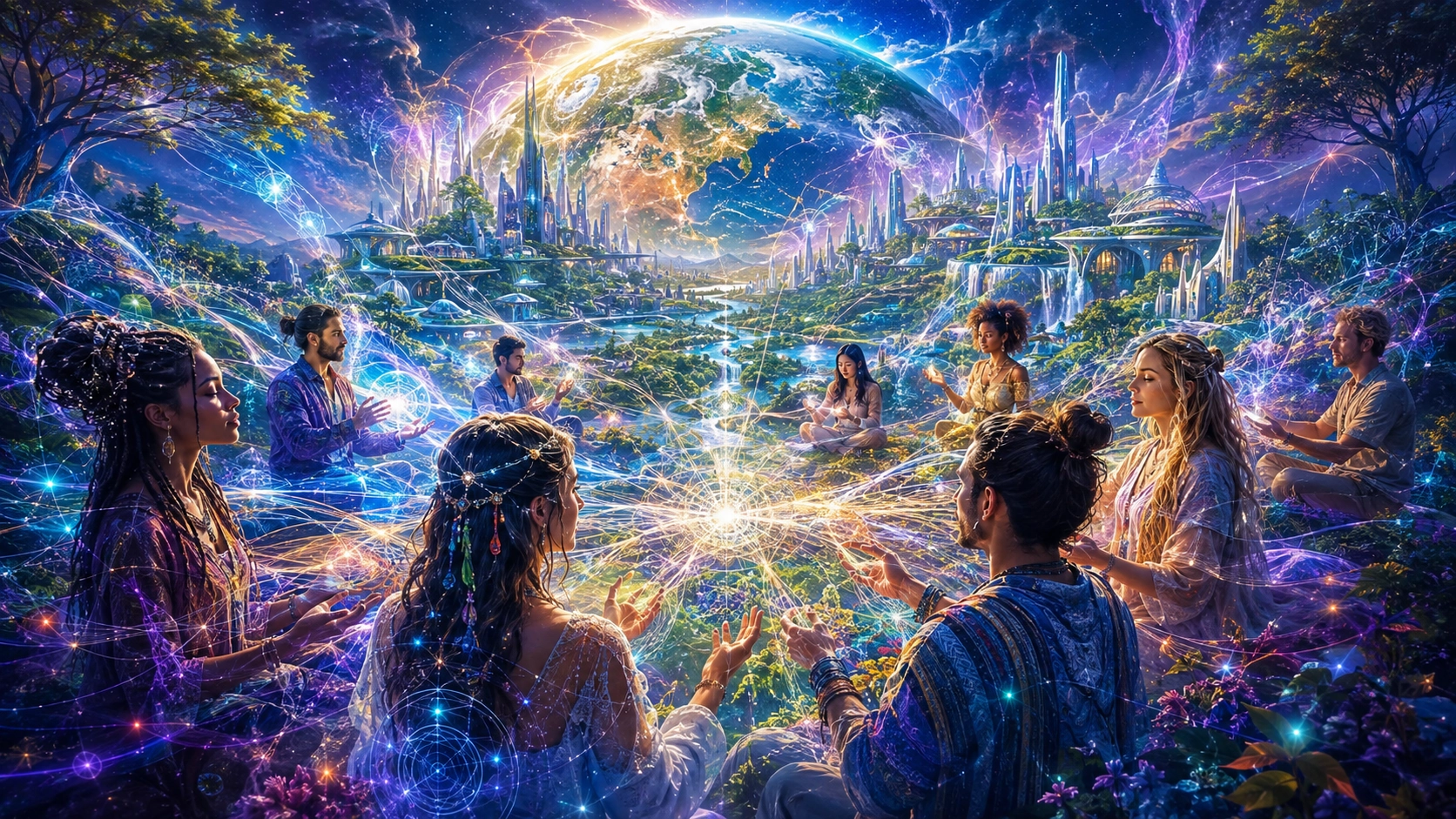
The New Earth is a collective manifestation.
It comes into being when many people begin to direct their attention towards a similar vision, feel the possibility of its existence and act as though the new direction were genuinely available. Individual intentions begin to meet. From individual images, emotions, decisions and actions, a shared field of consciousness emerges — the egregore of the New Earth.
This is not an egregore built upon fear, conflict and the need to have an enemy. Its energy is cooperation, freedom, responsibility, creativity, gratitude, the protection of life and the conviction that humanity can create solutions greater than its previous limitations.
Every person who sustains this intention contributes their own part to the collective manifestation. One creates a vision of the future. Another builds technology. Someone establishes a community, helps another human being, heals a relationship, plants a forest, designs a home, shares knowledge or demonstrates through their own life that it is possible to exist without constant conflict.
Collective manifestation does not mean that one person imposes their own vision on everyone else. It is not collective control. It is a meeting of free people who recognise a similar direction and begin consciously to nourish it with their attention, emotions and actions.
The more people genuinely feel the possibility of the New Earth’s existence, the stronger its collective field becomes. What was previously only a distant idea held by isolated individuals begins to appear in conversations, relationships, projects, inventions, local communities and decisions made every day.
First, the New Earth exists in consciousness.
Then it becomes a shared intention.
Next, it appears in people’s behaviour, in the way they create relationships, use technology and organise life together.
Finally, it takes physical form.
Together, we can imagine cities connected with nature, technology that gives people back their time, an economy that serves life, a world without wars and communities based on freedom, dignity and cooperation. We can enter the inner state of people for whom such a reality is natural — and take actions that allow it gradually to materialise.
We do not have to wait for the entire world to believe in the same vision at the same time. Collective manifestation begins with those who are the first to be ready to see it, feel it and begin living according to it.
We choose a shared direction. We sustain its image. We nourish it with emotion. We connect with people who feel a similar calling. We recognise emerging opportunities and give the vision an increasingly material form.
This is how personal manifestation connects with collective manifestation.
And this is how the consciousness of many people begins to create the reality of the New Earth.
A further horizon — immediate manifestation of matter
We can take this vision even further.
Today, we most often describe manifestation as a process. An intention, an inner image, emotional attunement, action, synchronicity, an encounter or an opportunity appears, followed by the result. Between imagination and physical experience, there is a certain amount of time and a path to travel.
This does not necessarily mean that this distance will always remain the same.
It is possible that, as human consciousness develops, our connection with Source deepens and collective coherence grows, the time between an intention and its material expression will become shorter. Manifestation may become increasingly direct until, at a certain level, it takes an immediate form.
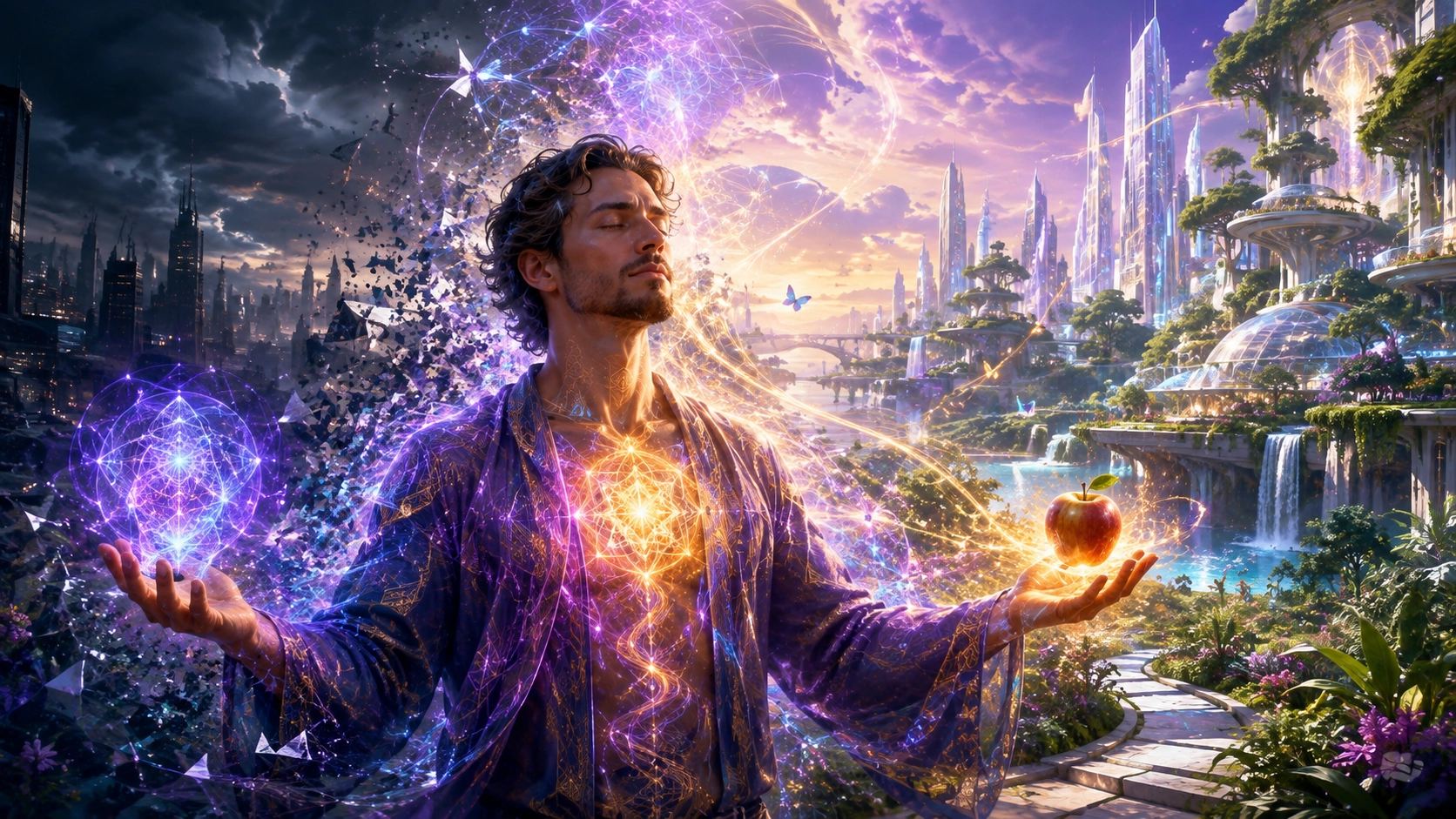
Within the further horizon of the New Earth, we can allow for the possibility that human beings will be able to influence matter through consciousness in a way that seems impossible today.
A person might, for example, imagine an apple, combine that image with the complete inner feeling of its existence and then manifest it in physical form — so that it can be picked up and eaten.
This would not necessarily mean unlimited power over the whole of reality. Perhaps this ability would operate within a certain scope and require a high level of consciousness, inner coherence, responsibility and connection with the collective field of the New Earth.
Many spiritual traditions preserve stories about consciousness influencing matter. In biblical accounts, Jesus multiplied bread and fish, turned water into wine and performed deeds that extended beyond the ordinary understanding of the laws of physical reality.
These stories can be understood religiously, spiritually or symbolically. They nevertheless preserve an important idea: consciousness in complete connection with Source may possess capabilities far greater than those we currently consider natural.
Perhaps what was once described as a miracle is a sign of the potential of consciousness that we have not yet learned to understand or use consciously.
We are not presenting immediate materialisation as a skill that a person can activate today after reading a few sentences. It is a further metaphysical horizon of our vision — a possibility to which we remain open.
If collective consciousness influences the conditions in which we create, the egregore of the New Earth may be a space that supports the development of abilities which, in the present world, appear only in stories, individual experiences or glimpses.
In such a world, imagination would no longer be only a tool for planning the future. It could become a direct instrument for giving form to matter.
First, we create the image.
Then we fully feel its existence.
And at the highest development of conscious creation — image and matter meet almost in the same moment.
Perhaps this is the direction in which the further evolution of manifestation is leading: from a long wait for the result, through an increasingly rapid response from reality, to the conscious co-creation of matter.
This does not have to happen immediately for us to begin building, today, the consciousness that may one day become capable of it.
Reality begins in consciousness
Conscious creation does not provide one simple answer to every question. It is a practice, an experience and a direction for exploring our own relationship with reality.
It is not about passively waiting for a miracle. It is about co-creation — the meeting of consciousness, intention, emotion, openness, action and a reality that does not always respond as we planned, but sometimes responds in a way that is far greater, more precise or more surprising.
We can begin with one chosen direction. With one image. With one emotion that we stop postponing until an external result appears. With one programming question. With one action taken from the level of the person we are becoming.
We do not have to know immediately where psychology ends, where metaphysics begins and how many possibilities of consciousness still remain undiscovered.
We can observe. Experience. Create. Remain open. Recognise the responses. Learn to use our attention and imagination responsibly.
First, the inner image changes.
Then the way we feel, see and act changes.
And then reality may begin to respond.
This is how we create our own lives.
This is how we manifest the New Earth together.