About me
Jaroslaw 33 — I have always wanted to know what lies beyond the map
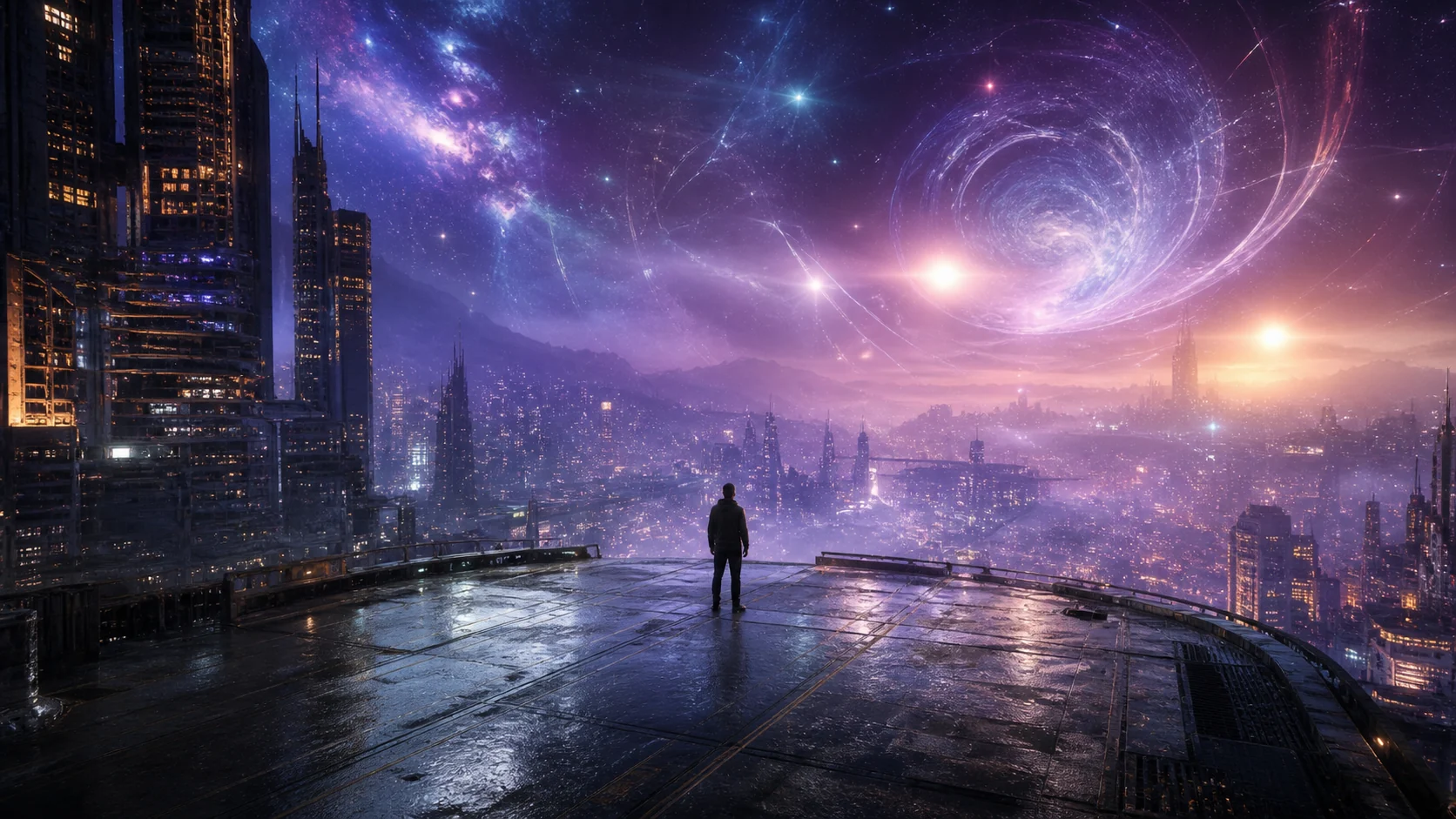
When I was a child, I asked questions that were difficult to answer. I used to ask about “the end of letters”. I was fascinated by the idea that something could come to an end, but even more fascinated by the possibility that it might have no end at all.
I wondered what would happen if I started flying straight upwards and never stopped. Where would I end up? When would I have to stop? And if there was some final boundary, what would be beyond it? Another space? Emptiness? Another world?
Surely, even beyond the end, there would have to be some kind of “further”.
I did not know the language of philosophy back then. I had a curiosity that would not leave me alone. “That’s just the way it is” was rarely enough of an answer.
Today, I can see that throughout my life I have kept returning to a similar question: what lies beyond what I already know — beyond the image, beyond the accepted rules, beyond the map I have learned to navigate?
A child who also observed himself
From an early age, I analysed not only the world around me, but also myself. My behaviour, reactions and emotions. I wondered why I had said something, why I had become angry, why I could feel at ease in one situation and withdraw into myself in another.
That self-observation has stayed with me to this day.
I can revisit a conversation, take it apart and look for something I did not notice before. I examine what I feel, how I react, and what a particular person or situation brings out in me. Sometimes it helps me understand myself. Sometimes it is exhausting, because it is difficult to switch off the analysis and simply rest.
My childhood was not a peaceful space in which to discover the world. What comes back from it is tension, shame, fear of other people’s reactions, and the feeling that I had to be careful. Alongside curiosity, I developed an early need to understand why people could hurt one another so deeply.
I kept a diary. I tried to preserve a place where I could say what I could not express out loud. Between those pages, I had a little space of my own. I could examine my thoughts before someone had the chance to tell me what I should think.
Beyond the boundaries of the game
The same search appeared in computer games.
Alongside playing the game itself, I was interested in where its created world ended. I looked for a place where I could get outside the map — beyond the terrain I was supposed to explore, beyond the walls and limits set by the developers.
I wanted to see the space without graphics. To fly further, even if there was nothing left that resembled the normal game.
In practically every game I played, I managed to find a way to get outside the map. Beyond its boundaries.
There was something fascinating about the moment when the buildings, the landscape and all the carefully constructed scenery came to an end. What remained was a space the player was never meant to see. The world on the screen suddenly revealed its edges.
Today, that image captures part of the way I think. I see a system and want to know how it works. Where are its limits? Which ones are real, and which ones has someone simply put in place? Is there another path besides the one everyone before me has accepted as the only option?
The questions grew harsher
As I grew older, I asked less about the boundaries of space and more about people.
Why do we repeat behaviours that make us suffer? Why do words so often fail to match actions? Why does someone demand respect while denying it to others? Why is it so difficult to admit a mistake or recognise our own part in a problem?
Sometimes I put it bluntly: “Why are people so blind and stupid?”
And many of the questions in my head back then were even harsher. Much harsher.
They were filled with disappointment, anger and helplessness at what I saw. I could not understand why so many people would defend something that was destroying them, or repeat other people’s beliefs without stopping even for a moment to examine them.
At the same time, I had long been looking at myself too. At my own blind spots, contradictions, and the situations in which I acted differently from what my understanding would have led me to do.
That is why psychology interests me. I want to know what drives us. How do our patterns develop? Why do we slip so easily into familiar roles? What makes us sometimes defend our own prison because at least we know its walls?
Leaving the body, leaving the map
During my teenage years, my search expanded to include consciousness, dreams and out-of-body experiences. I read, tried different practices and recorded my observations.
I began having experiences that felt like leaving my body. In my own personal language, this was another way of “going beyond the map”, this time without a computer screen.
The questions from childhood returned, only in a different form. Where does what I know about myself end? What is the space I perceive? How much does my picture of the world depend on the way I experience it?
The theme of boundaries runs through my whole life. The boundary between the visible and the invisible, between an automatic reaction and a conscious choice, between the world I found myself in and the one I would like to help create.
A lot of empathy, a lot of inner anger
I have a great deal of empathy, but also an enormous amount of inner anger. Both are true.
Suffering, humiliation and injustice affect me deeply. It matters to me that another person does not feel inferior, threatened or forced to constantly prove their worth around me. At the same time, I can be overwhelmed, irritable and full of tension myself.
I do not want to present myself as someone who always reacts calmly and understands everything. There is also a part of me that rebels, has had enough, and does not know what to do with all the emotions that have built up.
Often, I understand something in my head, but then go through life on autopilot anyway. I know which pattern is being triggered, I can name it, and yet I still react in the old way. Only afterwards do I realise that I have gone down the same road again.
For me, this is where the real work on myself begins. In that specific moment when I can notice a reaction a little earlier. Pause. Say something differently. Set a boundary. Or, after making a mistake, come back and take responsibility for it.
I do not always manage it. But I want to see what I am doing instead of endlessly pretending that the problem exists only outside me.
Life has not been easy on me
Depression, fibromyalgia, anxiety and personality disorders are part of my everyday life. They affect my life, but they do not describe everything I am.
Pain, tension and fluctuating energy levels affect what I can do. There are days when I can create, learn and develop several things. There are also days when I need to slow down and adapt my plans to what my body allows.
I do not want to tell a story in which all it took was thinking the right way for every difficulty to disappear. My path is not that simple. Nor do I believe that every instance of suffering was necessary, or that it needs a beautiful explanation.
Even so, I believe it is better to try to turn something negative into something positive than to sink into darkness and hurt other people.
I do not have to pass on everything that has happened to me. I can try to turn some of the pain into understanding, anger into a boundary, and chaos into something I can create. Sometimes that will be a piece of writing. Sometimes a film. Sometimes an ordinary conversation in which I do not treat another person the way I was once treated.
It is not about pretending to be full of light. It is about not losing the possibility of choice in the darkness.
Egregores — what we give our attention to
In the language of New Earth, I use the concept of egregores. For me, they are a metaphor for collective patterns, stories and emotions that people sustain through shared attention.
I imagine them as vast cities built not from concrete, but from repeated thoughts. Every conversation lights up another window. Every reaction adds another piece to the story. Some of these spaces help people work together. Others organise their lives around fear, shame, hostility or the need to constantly prove that they are right.
This image helps me look at very ordinary situations.
I go online for just a moment. I see something that affects me. I read the comments, reply, and come back to check for a response. An hour passes, and I am still having a conversation in my head with someone I do not even know. My own day is standing still, but the conflict is developing perfectly.
That is what I mean by giving my attention to a destructive egregore.
I can be against a particular story and still spend the entire day living inside it. In that case, my opposition does not give me freedom. I am still organising my life around what I do not want.
So I begin to ask: what am I spending my time on? What am I reinforcing through my behaviour? Do I have more clarity after this conversation, or just a stronger urge for another round?
I have chosen a direction, and I am simply following it
I do not want to spend my life fighting every egregore, someone else’s beliefs, or every rule that does not suit me. I do not have to convince the whole world before I can start building something of my own. I can create alongside it — develop my own space, meet people heading in a similar direction, and see what comes of it.
I do not need to turn this into a grand mission or attach enormous importance to every step. I am here, in this life, simply doing my thing. I have an idea, so I try it. Some things work; others need adjusting. Sometimes I rest, sometimes I change the plan. I want there to be room for ease, curiosity and the simple pleasure of creating too.
I have made a choice: I want to move towards New Earth. Towards greater awareness, freedom, empathy and cooperation. And that is the direction I am taking, at my own pace. I do not have to prove every day that it is a big deal, or make my self-worth depend on how quickly I see results.
I can take my direction seriously without getting wound up over every outcome. Not everything has to work out exactly as I imagined.
That does not mean accepting harm. I can still say “no”, set a boundary or walk away. I simply do not want to remain in every fight forever. I would rather keep some time and attention for the life I have chosen.
Two timelines. Two egregores.
When I think about Old Earth and New Earth, I see two directions. Two different ways of responding to the same experience.
In my vision, timelines branch out like paths of light in the darkness. One returns to familiar reactions: fear, domination, humiliation and the struggle for the upper hand. The other leads towards greater awareness, cooperation, freedom and responsibility.
Old Earth and New Earth are my names for these directions. This is not a division of people into two kinds — good and bad. I recognise both possibilities within myself too.
I am hurt. I can pass that hurt on, or try to break the chain.
I am furious. I can humiliate someone, or state clearly what I will not accept.
I see a problem. I can give it all my attention, or devote some of that attention to a solution.
That is how I understand choosing a timeline in everyday life. Not everything is up to me. I do not choose every circumstance or other people’s decisions. But wherever I have even a little influence, I can look for a different response from the one that used to happen automatically.
In this picture, there are more than just two possibilities. The future resembles a branching map, while Old Earth and New Earth point me towards a general direction. I do not need to know the whole route to take one step.
Sometimes that step is small and completely unremarkable. Turning off my phone. Resting. Keeping my word. Apologising. Doing something I have been putting off all week.
For me, it is in moments like these that big ideas meet real life.
New Earth cannot become another form of coercion
If I talk about two egregores, I also want to be careful about what we build under the name of New Earth.
I do not want a space where people have to think alike to deserve respect. I do not want to replace one set of demands with another, or create yet another group that needs an enemy in order to feel united.
Our vision should leave room for questions, disagreement and the freedom to leave. For people who understand spirituality differently, or do not use spiritual language at all.
If something is going to connect us, I would like it to be visible in the way we act: in honesty, cooperation, respect for boundaries, and how we treat a person who has nothing to offer us.
A shared story should help us live. Not take over our whole lives.
Numerology and something written in the soul
Numerology is one of the languages through which I look at my own story. I feel drawn to the idea, found in its spiritual interpretations, of people coming into the world to bring greater awareness and “raise vibrations”.
There is something in that story that speaks to me. Sometimes I wonder whether my constant questions, my need to understand, and my refusal to accept the mindless hurting of others are something I could describe, in spiritual language, as written in the soul.
Like a theme that returns in different chapters of life. First as a child’s question about infinity. Later as a search for a way beyond the map. Today as a need to create something that holds meaning for me.
This is a personal way of making sense of my path. I do not need everyone to read it in the same way.
If I talk about raising vibrations, I want to translate that into ordinary life too: more empathy, honesty, responsibility and conscious decisions. Otherwise, even the most beautiful words will remain nothing more than decoration.
Why I am creating New Earth Studio
Today, I combine my interest in people with technology, artificial intelligence, imagery, film and music. I like testing, trying, improving and seeing an idea take a tangible form.
I am drawn to cyberpunk and psychedelic imagination. Neon reflected in water. A city submerged in shadow. Light breaking through a storm. A familiar landscape that suddenly reveals a passage into something new.
In images like these, I find a language for my own experiences and questions. I can show the tension between technology and the human being, between overwhelm and silence, between what we have inherited and what we are only beginning to imagine.
New Earth Studio is a place where these interests can meet. I want to share reflections, create material and gradually develop practical ideas connected with New Earth.
I do not want this entire project to be built solely on anger towards the old world. I know that anger, and I know how much space it can take up. I want to direct some of that attention towards what we could do differently.
That is why I say “our vision”, not just “mine”.
I see a space here for people with different experiences who still want to create something worthwhile together. We do not have to agree on everything. We can meet around a single idea, a single conversation or a single action.
I am not arriving as a finished version of myself. I still ask questions, analyse, make mistakes and change my mind. This website will grow along with me.
We bid the old Earth farewell with love
When I say, “Together, we create New Earth, and bid the old Earth farewell with love,” I do not mean erasing what happened or excusing harm.
I mean not letting the past occupy the whole future.
I can remember. I can learn. I can choose not to return to places and relationships that were damaging me. At the same time, I want to leave myself open to experiencing something I do not yet know.
I do not have to spend the rest of my life standing in front of closed doors, explaining why they should open.
There are other paths. Other encounters. Other things to create.
I used to look for a place where I could fly beyond the map.
Today, I also ask: what do we want to build together when we discover that the map we know is not the only possibility?