The New Earth in Everyday Life
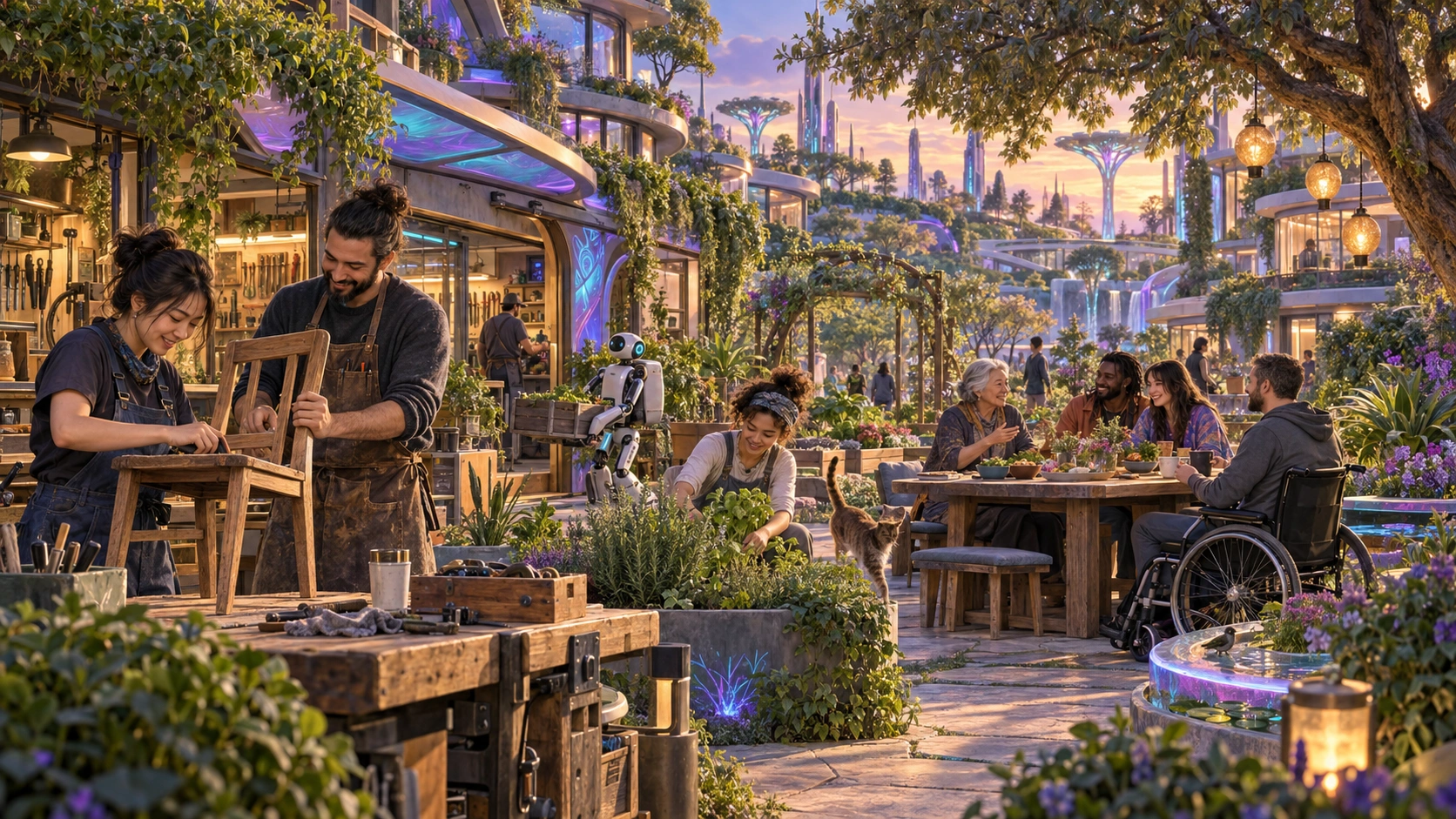
What life could look like when we have time for ourselves, use technology wisely and know how to be close to one another.
Imagine an ordinary morning. The day is waking up outside your window. At home, there is room for quiet, breakfast and a short conversation. You head out to work, school or a project of your own. On the way, you pass a garden where someone watered the herbs yesterday, and a workshop where you can bring something that needs repairing. You know where to find help, and your responsibilities also leave you time to live.
This is what a day in the New Earth could look like. It is our picture of a future organised around people, their needs and their possibilities. Individual elements can already be found in different places. Others need ideas, work, agreement and testing in real conditions.
Let us walk through this day. Let us see what living in it could feel like and what would allow this kind of everyday life to continue.
Morning — a home where you can breathe freely
You get up and draw back the curtains. For a moment, you look at the light, hear the sounds of your home and notice your own breathing. You might drink tea, pray, sit quietly or go straight to preparing breakfast. The beginning of the day has room for your own way of being.
In our vision, every person should have real access to a safe place to live. A home provides somewhere to sleep, keep your belongings, prepare a meal and close the door when you need privacy. It is a point of support for the rest of your life.
If we live together, we know who is taking the child to school today, preparing food and dealing with something that needs attention. This division can change. Someone has more work, someone needs rest, someone is recovering their strength. We talk about it early enough for several people to share in the daily care.
A person living alone can value their home and also need help. What matters is knowing whom to approach with a difficulty and where to meet others when they wish to. Having your own space and a connection with the people around you can work well together.
A moment of gratitude has a place here. So do a working tap, heating, a sense of safety and help that is available. A peaceful morning grows out of conditions we know how to care for together.
The journey — surroundings that make life easier
When you leave home, you reach a street where people can move about freely. There is room to walk, use a wheelchair and rest. An older person sits on a bench. A parent takes a child to school. Someone is travelling to work, someone else is heading to the library or a meeting.
We imagine towns and neighbourhoods where many ordinary needs can be met close to home. Accessible transport connects more distant places. When designing a route, we also consider someone who needs more time, finds it difficult to move around or does not use a smartphone.
Herbs grow beside the bus stop. Along the path is a small garden cared for by residents. People know what they can pick and how to join in the work. One person waters, another prepares seedlings, and someone labels the plants so that others can recognise them.
A space like this needs care: repairing a bench, keeping a path clear, collecting waste and agreeing on how to use the garden beds. We see the results of this work during an ordinary walk. Our surroundings become easy to understand, welcoming and accessible to different people.
Passing a neighbour, we can exchange a few words. We can also simply say hello and carry on. A good place allows us to meet another person while leaving us our own pace.
Work — a useful contribution and time for your own life
In the workshop, the team begins by briefly agreeing on the tasks. Someone understands the needs of the people the work is for, someone prepares the design, and someone knows how to make it. A newcomer receives an explanation and the chance to ask questions. People understand why they are doing their part and how it connects with everyone else's work.
In the vision we are developing, AI would help with repetitive tasks, finding useful information or preparing an initial proposal for a solution. A robot could support work involving heavy components. Each use would require suitable preparation and checks. People would remain responsible for quality and for decisions affecting others.
The practical benefit would be visible during the working day: less unnecessary copying, safer completion of a task and easier access to knowledge. How much time we actually recover would also depend on organisation and how the benefits are shared. A shorter task can leave room for rest, learning or finishing work earlier.
The team has arranged cover. Someone may become ill, need time off or have an important family matter to attend to. Knowledge is passed on, tasks have clearly identified people responsible for them, and expectations reflect what people can actually do. At the end of a shift, a person can return to their own life.
Contributing to the New Earth takes many forms. Caring for a loved one, raising a child and maintaining a home also require time and skills. In our everyday life, we seek to recognise these contributions and provide support for the people who take on these responsibilities.
Food — from the garden to a shared table
At midday, the kitchen smells of a meal being prepared. Someone has brought vegetables, someone is cooking, and someone is setting the table. Conversation begins while chopping and stirring. A person who does not yet know their neighbours can easily find a small task and an opportunity to meet them.
In this vision, food connects different places: a farm, a local shop, a home kitchen, a garden and a place for sharing surplus food. A producer sells the fruits of their work on fair terms. Available produce can be picked from a public garden bed according to agreed rules. Surplus food that has been stored appropriately can reach someone who will use it.
Each of these forms has its own conditions. A shared kitchen needs to be kept tidy, a garden needs watering, and a food-sharing point needs someone to look after it and people to follow its rules about products. This is care for those who will come later and rely on other people's work.
At the table, we can slow down for a moment. Notice the taste and the people beside us. Appreciate the journey the food has made before reaching our plate. For some, this will also be a moment of spiritual gratitude and a sense of connection with the Earth.
You can eat alone, bring your own meal or join in briefly. A shared place should leave these possibilities open. Gardening and sharing surplus food are part of a broader concern for nourishment; we also need continuity of supply and help for people who lack basic resources.
Objects — access, repair and durability
After work, you need a tool for one task. At a nearby lending service, you check whether it is available and agree on when to return it. The person looking after the service explains how it works. Someone without a phone can make the same arrangements during an in-person session.
Once the task is finished, the equipment comes back clean and complete. If there has been a problem, you report it so that the next person receives something that works. The lending service has funds for inspections, repairs and running the service. Charges or arrangements for shared funding are known before you use it.
A few doors away, there is a repair workshop. You bring a chair with a part that needs fixing. A person with the appropriate skills examines it and explains a possible solution. You can take part in the work and learn something new. When a specialist is needed, people know where to look.
Personal possessions still have a place. Some things are useful to keep close at hand; others can be shared or borrowed. The decision depends on needs, availability and costs. Convenient access to good equipment gives us more choice.
In surroundings like these, the ability to repair things becomes visible and appreciated. Someone understands wood, someone sews, someone knows how to care for a bicycle. Meeting around a particular object can leave behind both a working item and a new acquaintance.
Learning — curiosity throughout life
In the garden, children ask why one plant needs more light. A knowledgeable practitioner shows them different spots and helps them compare what they see. Later, they can write down an observation, draw it or prepare a small experiment of their own with a teacher's guidance.
We imagine learning in which knowledge meets experience. A school, library, workshop and shared project offer different ways to explore the world. People who know how to teach, materials and time to understand are all needed. A question can begin something valuable even when it sounds very simple.
In the afternoon, an adult comes to learn a skill needed for a project of their own. Someone else shares experience gained over many years. Age does not close off a place at the table, and a person starting with the basics can speak openly about what they do not yet understand.
Technology could help select exercises, explain a subject in different ways and make materials available. Its output would need checking, and users would retain access to a person able to explain something unclear. Different learning speeds are one of the conditions worth considering when making arrangements.
A shared task also gives us a chance to learn cooperation. One person prepares the material, another notices a mistake, and a third suggests an improvement. We can discover our own abilities and see how well they complement other people's skills.
The neighbourhood — people we know
In an open neighbourhood space, someone is practising music, someone is talking at a table, and someone brings an idea for a shared event. You can come for longer or drop in for a few minutes. A newcomer learns what happens here and how to join in.
A place like this offers the chance to get to know people outside the rush of an ordinary day. In time, we know who is interested in gardening, who likes books and who can help with a particular task. It is easier to ask someone a question when we have already exchanged a few calm words with them.
Help begins with understanding the need. A neighbour may want company, support with shopping or an explanation of something they do not understand. They may also need privacy. Their answer helps us agree on what would actually be useful.
Taking part in neighbourhood life remains voluntary. People may have different beliefs, different daily rhythms and different levels of readiness to meet others. Living together rests on an agreed way of using the space and respect for other people's personal space.
We share tasks in ways that make the common space accessible to people who have less energy or time as well. Someone looks after the garden, someone explains the rules to newcomers, someone contributes an idea, and someone, at this stage in their life, mainly receives support. A person's circumstances can change.
A harder day — help that actually works
One day, the person looking after the garden cannot come. They inform someone who knows the tasks and can take over. The watering is done, and they have the chance to rest. The shared space continues to function because knowledge was passed on beforehand.
Another time, a borrowed item comes back damaged. The person responsible records what has happened and takes it out of use until it has been checked. They discuss the circumstances with the user and agree on the next steps according to the rules. The next person knows why the equipment is temporarily unavailable.
Someone may need help that goes beyond their neighbours' abilities. What matters is being able to point them towards appropriate support and respect their privacy. When a matter requires a specialist, we draw on the relevant expertise. When there is danger, we take the necessary protective action.
In this everyday life, it is also possible to say: I have too many responsibilities at the moment. That information helps us review how work is shared. An extra person, a change in hours, payment for a regular task or a smaller shared undertaking may be needed. A solution should fit the people who keep it running.
A harder day belongs to the same life as a pleasant one. A person retains the right to be treated with dignity when tired, ill or in need of help. The quality of a community is also visible in the support they find beside them at such times.
Evening — time we can spend in our own way
You return home. You can sit down with a project of your own, listen to music, meet someone close to you or go for a walk. You can also do very little and let the day come to a quiet end. You have room to notice what you need now.
Creativity can be a simple part of life: a few sentences written down, a melody, a drawing or an idea for a small garden. You can make something for your own enjoyment, show it to friends or develop it together. Having your own time gives you the opportunity to discover this part of yourself.
The internet can also serve meeting, learning and creating. We can use a tool, speak to someone far away and finish using it when we wish to return to the home around us. Our availability to others has its own agreed boundaries.
Not everyone rests in the evening. Someone is starting a shift, someone is caring for a loved one, someone sleeps at different hours. Organising a good life takes these rhythms into account: quiet for a neighbour, cover for care responsibilities and rest after work. The day proposed here is one possible picture.
In a world like this, free time has real support. It grows out of how we organise work, share responsibilities and respect privacy. We can spend time with another person or with ourselves, without having to fill every moment with another task.
From a picture of a day to one working solution
Individual parts of this vision already have examples today. Incredible Edible describes growing produce available to residents, Repair Café describes shared repair gatherings, and Library of Things describes paid hire of useful equipment. These are different initiatives with their own rules. We can learn about their experiences and look for solutions that suit our own place.
Imagine a few people who need tools only from time to time. They begin with a conversation: which items would actually be used, where could they be stored, and who could manage the borrowing? They choose a small scope they can sustain.
They agree on a person responsible and someone to provide cover. They check the equipment's condition and the rules for safe use. A booking can be made during an in-person session or remotely. Before borrowing, people know when the item must come back and how to report a problem.
The costs still need covering: purchase, storage, inspections, repairs and running the service. Depending on the circumstances, this could be an agreed shared budget, a grant or a clearly explained charge. Every participant understands the rules before making a decision. Volunteers' work also has a defined scope and time commitment.
After a while, they look at how it is working. Are people using the equipment? Is it being returned on time? Can the costs be covered? Does the person responsible have enough support? Their answers can help them improve the rules, change the equipment or stay small.
In this way, the picture of a calmer day begins to have its own place, people and continuity. Today, someone borrows a tool; tomorrow, another person uses something that has been repaired. Behind this ordinary experience are someone's knowledge, care and work.
In our spiritual language, this shared direction helps create the New Earth. In everyday life, we can recognise it in a home that provides support, help that is available and responsibilities that also leave time to live. In the evening, we return to the person from the first scene. They can calmly close the door and rest, knowing that tomorrow they have something to come back to.