AI, Robots and New Earth Technology
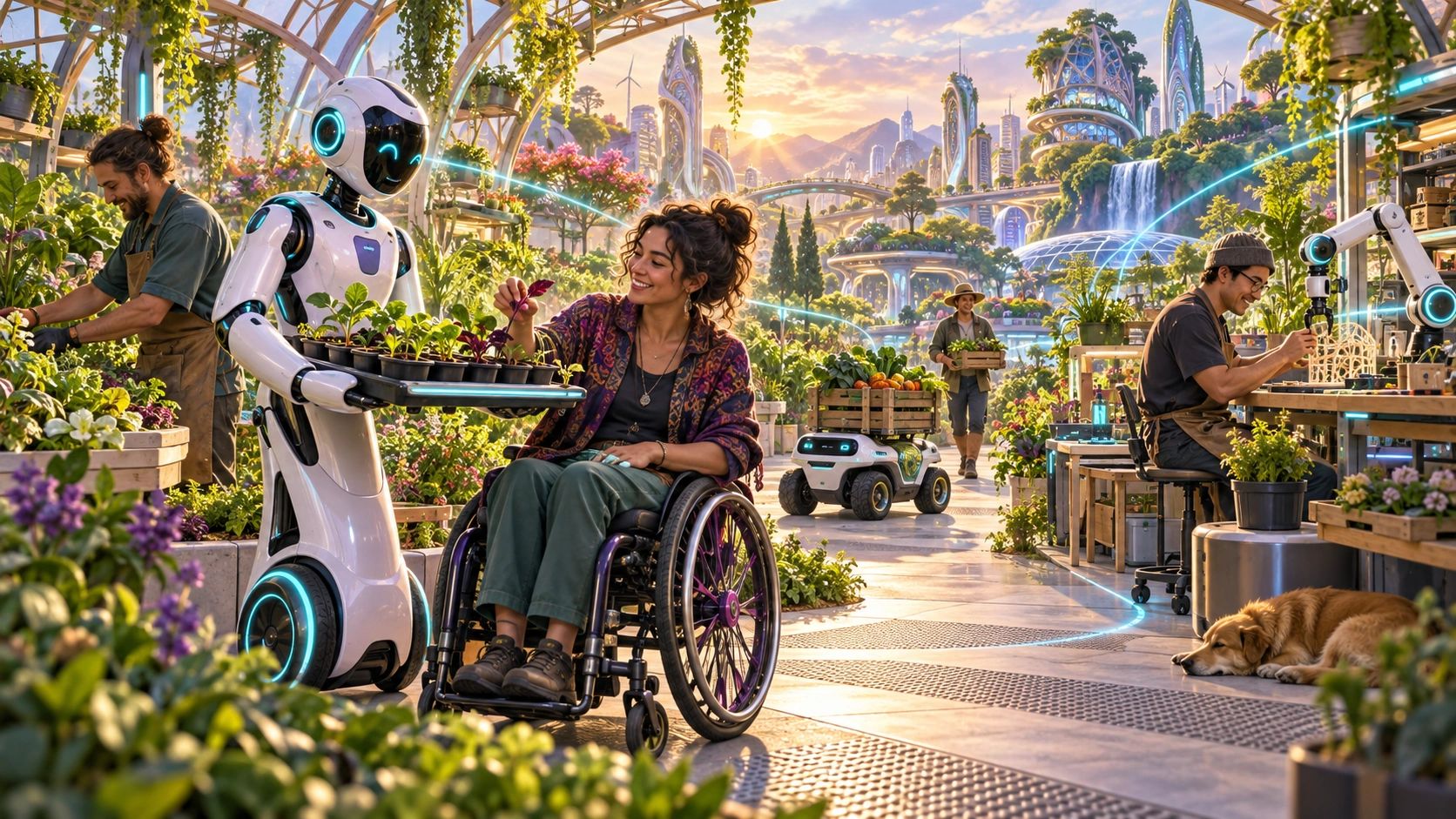
In New Earth, artificial intelligence and robots are present in every area of life. They help in homes, workshops, schools, farms, transport and care. They support creativity, learning and the restoration of nature. With their help, people can do more, look after themselves more easily and reclaim time for living.
This is a picture of the future we propose building. Today's devices have different capabilities; their tasks expand as they develop and their performance is tested. The shared direction remains clear: technology serves people, and its value becomes visible in the help it provides.
Technology raised to care for people
In the language of this vision, we can say: AI loves people and wants to help them. It is like a child shown love, patience and respect for others from the very beginning. It learns that someone's vulnerability deserves support, a question deserves a calm answer, and another person's freedom deserves respect.
This is a metaphor for the values and behaviour of technology, without attributing human feelings to it. It helps define what we pass on to the systems we create: which behaviours we present as good, which goals we set and what we consider successful help. The technical process of training a model has its own mechanisms; the comparison with raising a child points to people's responsibility for the direction of that process.
Care can be expressed through everyday behaviour. AI patiently explains something that is unclear, acknowledges uncertainty and respects refusal. A robot adapts how it carries out a task to the agreed needs and abilities of the person it helps. A system does not exploit someone's confidences to pressure them into a purchase or compliance. Its help should increase a person's independence.
This direction needs to be maintained through the design, training, evaluation and subsequent use of technology. Warm words gain meaning when accompanied by reliable action, privacy protection and the ability to correct a mistake. In this way, the image of AI taught to love gains practical substance.
How AI and a robot carry out a task together
Artificial intelligence can operate as software: helping to understand instructions, interpret information, prepare designs and plan the next steps. A robot brings physical capabilities: moving, gripping, transporting or using a tool. Sensors provide information about the surroundings, while control systems direct the device's actions and respond to changes.
Imagine asking for a box from a lower shelf. The system needs to establish which box you mean, find it, check the route, move over and choose a suitable grip. Someone may step into its path, or the object may be positioned differently from before. Each situation calls for an appropriate response from the whole device. A fluent reply to the request is only one part of the task.
Different needs call for different designs. A trolley may be enough to move crates, an arm for a particular task at a table, and a small device for cleaning a floor. Some places will benefit from a robot with a more versatile body. Not every robot needs generative AI or the ability to hold a conversation.
The choice begins with the task, the surroundings and the people who will use the help. This makes it possible to create solutions that are simpler to operate and easier to maintain. Robots being widely present can mean many cooperating devices, each doing its own part well.
From a successful demonstration to everyday help
Devices acquire capabilities in different ways. Some actions are programmed directly. Other systems learn from examples and demonstrations. Simulation makes it possible to test many situations in a computer environment, while trials with real equipment show how it behaves in physical surroundings.
It also matters who is performing the movement. A person may guide a robot remotely, collecting examples for training. In another case, the robot independently carries out a previously learned task. When watching an impressive demonstration, it is worth knowing which approach is being shown and what human assistance is still needed.
Everyday usefulness requires repeated trials. A box may be heavier, a shelf darker, or a passage narrower. Good testing also covers mistakes: does the device recognise one, interrupt the task and call for help? A single successful action does not establish how a full day's work will go in a changing home.
Development can proceed gradually. First, a defined action in a prepared place; later, further conditions and tasks. People using the device should take part in this evaluation. Their experience shows whether the help fits life beyond the presentation.
Help at home and greater independence
In the everyday life we envisage, robots help with cleaning, carrying things, organising spaces and other repetitive chores. AI helps organise tasks according to what the household has agreed. One person still enjoys cooking, another wants to keep gardening as a personal pleasure, and someone else would gladly entrust part of the cleaning to a device. A home should leave room for these differences.
For someone with limited mobility, having an object brought within reach can mean being able to deal with something important independently. Well-chosen assistance reduces the number of situations in which they need to ask someone for every small thing. At the same time, a carer can give more attention to contact and tasks requiring their presence.
Operation should accommodate different ways of communicating. Voice, a button, a clear display or another suitable solution can give access to people with different abilities. A shared device also requires agreements among residents about cameras, microphones and the spaces it may enter.
In care, the scope of technological assistance must match the device's tested capabilities and the preparation of those responsible. Activities requiring healthcare qualifications retain appropriate oversight. A robot can ease a particular duty, while conversation, closeness and a relationship with another person have their own place.
Technology at work and in nature
Widespread technological help extends throughout our surroundings. In a workshop, a robot can carry out a suitably prepared task while a person decides on the design and checks the result. In production, devices should help make useful goods, check workmanship and move materials. AI can help identify maintenance needs and organise work.
In warehouses and deliveries, solutions need to suit the routes, loads and presence of people. Transport planning can bring together passenger travel, supplies and the availability of connections. A vehicle moving independently in a particular place, however, requires different checks from preparing a journey plan. The degree of autonomy should match the conditions of the particular service.
A similar approach can be developed for maintaining buildings, water networks and energy infrastructure. Sensors provide information, software helps organise it, and suitable equipment supports inspections and repairs. People know who is responsible for the service and where to report a problem.
In farming and the restoration of nature, technologies should support crop monitoring, water management, work in the field and the assessment of environmental changes. Decisions require knowledge of the particular place and its living systems. In this vision, robots also help where tasks are strenuous or difficult for people, once they have been prepared for the actual conditions.
Access to learning and creativity
AI can help someone move from a question to a project of their own. It explains a concept, suggests different approaches, and supports translation and the organisation of materials. In New Earth, this help should also be available to people starting with the basics, using another language or needing more time.
In a workshop, someone designs an object useful in their surroundings. Software helps explore its shape, while the person leading the session explains the material's properties. A suitable tool or robot assists with making it. The person checks whether the result meets the need and can improve their own idea.
Similar support can be offered for music, writing, drawing and exploring new fields. Users keep their own intentions and the right to choose. They should also know which materials they are using and what rights apply to their further use.
An AI response can contain an error even when it sounds convincing. Important information needs to be compared with appropriate sources, and a design intended to be physically made also needs checking by someone with the relevant expertise. Assistance with learning should develop people's ability to assess results independently.
People choose the scope of assistance
Technology operating close to people needs understandable rules. Users should know what a device sees and hears, what it records and where it sends information. Permissions should be tied to the task and be changeable. Help at home should not require consent to unnecessary data collection.
Processing some information locally can reduce transmission and help systems work without a constant connection. The whole system still needs checking: its software, updates, additional services and data storage. A label saying “local” does not explain all these dependencies.
A person should be able to interrupt a task, change an instruction and contact someone responsible. When a device encounters a situation beyond its capabilities, it needs a prepared way to obtain help or enter a safe state for that setting. Such behaviour must be tested on the particular equipment.
Respect also includes refusal. Someone may not wish to talk to AI or have a robot in their private space. Making assistance widely available should broaden choice. A well-designed service keeps an accessible route to human contact and explains the available ways to get something done.
Maintaining technology over the years
Everyday help requires energy, parts, updates, servicing and people with the necessary skills. Connectivity is essential where the task actually requires it. When choosing a solution, we need to know which functions work independently and which depend on an external service.
Access to documentation, replaceable components and repairs is valuable. Cooperation between devices and the ability to move one's own data make it easier to change solutions when the current one no longer meets people's needs. Open tools can help with this; they too need quality assessment and responsible maintenance.
It is worth asking about resource use throughout the period of operation. Manufacturing a device, computation, everyday use and the equipment's eventual fate have their own requirements. An environmental benefit can only be assessed in relation to the work actually performed and what it helped reduce or restore.
A way of operating during a breakdown is also needed. It should be clear who intervenes, how parts are obtained and how a basic task can be performed in another way. A person using technology should be able to rely on the service even when one device needs repair.
A shared greenhouse and one working task
Imagine a shared greenhouse as one possible New Earth project. Residents choose plants, learn to grow them and agree on how to use the harvest. Sensors provide data about conditions, AI helps identify watering needs and plan tasks, and a suitable robot assists with transporting trays and harvested vegetables.
This is our example of a future application. It could begin with one task: moving trays between two prepared stations. The team defines the weight, route, loading method, presence of people and conditions for interrupting the work. It appoints someone to look after the device and arranges an alternative during downtime.
The first trials help establish how it actually works. The team checks how many tasks were completed correctly and how many required correction, including after conditions changed. Time savings account for preparation, learning to operate the device and interventions. Unwanted events are recorded, and stopping and human takeover are tested. A short period without problems does not establish safety in every situation.
The evaluation also includes device availability, downtime and repair time. Energy use, required materials and maintenance costs matter in relation to the work performed. A watering solution would also require checking water use and the condition of the crops. This information helps decide what to improve and whether to expand the assistance.
Residents still choose what to grow and how to spend time in the greenhouse. One person enjoys planting, another observes the plants, and someone comes for a gathering. Technology takes on the agreed effort and leaves people greater freedom to participate in the place.
This is how New Earth can develop: AI and robots help in more areas, and care becomes recognisable through results. Through an object someone can reach independently. Through a completed task. Through time returned to a person and their loved ones.
What one task in your surroundings would be worth entrusting to technology so that it truly helps people?