New Earth Education
A person finishes a lesson and can do something they did not understand before. Read a more demanding text, explain their own idea, check a piece of information or improve a solution. They also know what to ask when they get stuck. This is the kind of independence that New Earth education should develop.
In the future we propose, learning is accessible throughout life. It brings knowledge together with curiosity, practice with reflection, and the development of individual abilities with cooperation. Schools, libraries and open workshops provide places to explore the world. AI and robots offer widespread support in this process, while teachers have the conditions they need to teach, listen and help.
The aim is a person who understands more and more, can make informed decisions and has the courage to keep learning. They can develop in their own direction while respecting others.
Knowledge for understanding the world
Reading comprehension, writing and mathematics provide foundations for further learning. Natural science helps us explore our surroundings, history helps us understand changes in societies, and languages open up access to other people and their experiences. Art, music and movement each have their own place in human development.
We connect knowledge with a question: what can I use it for? Preparing a meal can involve practising proportions, reading instructions and learning to organise work. Planning an expense can involve comparing prices, calculating the full cost and checking how much will remain for other needs. A practical task gives meaning to the concepts being learnt.
Education also includes understanding information about health, our rights and how society works. We learn to find an appropriate source and recognise situations in which specialist help is needed. We explore ways to care for our shared surroundings and the consequences of everyday decisions.
These foundations should help people participate in life with increasing confidence and independence. A person can read the terms of a service, ask about a clause they do not understand, plan a task and explain why they chose a particular solution.
Curiosity and discovering our abilities
A child should have opportunities to try different fields. Play a simple melody, build a model, write a story, explore how a robot works or try woodworking. Through these experiences, they can notice what draws them in and what they would like to give more attention to.
Abilities need opportunities to develop. An unsuccessful first attempt does not close a path, and early success in one field need not determine an entire future. Someone may enjoy both movement and programming. Someone else may discover music years later. It is also possible to do something for pleasure, without an obligation to achieve exceptional results.
We combine shared learning foundations with a choice of a topic to explore more deeply, a project or a way of presenting work. The teacher helps define a goal that fits what the learner can already do. Interest provides direction, while further attempts and practice allow it to develop.
A person's path remains open. They can change their mind, return to an earlier interest and discover a field they previously knew little about.
Teachers and the conditions for good learning
A teacher brings knowledge and the ability to communicate it. They prepare a task, explain a necessary concept and show how they arrive at a solution. They notice when a learner has lost the thread and help identify the cause of the difficulty.
At first, support may be close: a worked example together, an additional question or a task divided into parts. Later, the learner takes greater responsibility. They try independently, explain their choice and check the result. The teacher adapts support to the situation, leaving room for the learner's own effort.
This work requires time to prepare lessons, talk and assess understanding. It needs materials, suitable equipment and opportunities to collaborate with other teachers. The person teaching should also have access to further learning, consultation and rest.
Families and schools can exchange information about a child's needs and agree on support. The learner's voice belongs in that conversation too. They experience the lessons every day and can say what they understand, what interests them and where they need help.
Open workshops and learning through doing
In New Earth, music, technology, art and craft workshops extend access to learning. Participants explore tools, materials and ways of working. They can meet someone who practises a particular profession and see the skills they use each day.
The practitioner demonstrates an activity and explains their decisions. The teacher helps turn the experience into a learning process: what we are exploring, what needs to be understood beforehand and how we will recognise progress. Using tools requires preparation, and supervision matches the participants' ages and the task.
There is room for explanation, demonstration and unhurried practice. A project offers an opportunity to bring these elements together. If something does not work, we look for the cause, improve a particular part and check again. The next version of the work can show what the previous attempt taught us.
For younger children, play also has an important place, with an adult creating conditions for exploring something specific and offering help as needed. Older learners and adults can take on more complex tasks. We choose the approach to suit the purpose and stage of learning.
Independent thinking and checking information
In New Earth education, we can ask: how do we know this? We learn to compare explanations, look for sources and distinguish an observed event from its interpretation. We should be able to justify our conclusions. New information may be a reason to revise them.
These skills are useful online too. When we encounter a sensational story, we check the author, date and original material. When considering something for sale, we ask about the seller's credibility and the terms of the transaction. We learn to notice pressure to decide quickly and protect the information we entrust to others.
We examine our own learning in a similar way. Before a task, we establish what needs to be done and what we already know. During it, we check where a difficulty arose. Afterwards, we try to explain the solution in our own words or apply it to a new example.
Independence also includes asking for help thoughtfully. We can identify a particular step we do not understand and work together to find a way forward. Saying “I do not understand this yet” provides useful information.
Emotions and working with others
Learning can bring joy, boredom, frustration and fear of making a mistake. It is worth learning to recognise these feelings and express needs in ways others can understand. We can ask for an explanation, a short break or help with a task.
Cooperation requires skills that we practise in real situations. We agree on roles, listen to a different idea and explain our own. When a disagreement arises, we return to the shared task and seek a solution that takes the participants into account. Adults demonstrate this way of talking through their own behaviour as well.
There is room in the group for someone who needs quiet, more time or another way to express themselves. It is worth agreeing on how they can participate before work begins. Everyone should know what they can contribute and whom to approach with a difficulty.
Participants retain the right to their own views and boundaries. Conversations about emotions require respect for privacy. Nobody has to share personal experiences publicly to demonstrate that they can listen and cooperate.
Expectations and respect when assessing progress
Learners should know the goal of their work and how it will be assessed. Specific feedback helps them see what they have already done well, where they made a mistake and how they can improve it. They also need time to use the guidance they receive.
We can say: “You used a different unit in this calculation. Let's check where we need to convert it.” This comment addresses the task and opens a way towards another attempt. We combine high expectations with explanation and accessible support.
Mocking questions, insulting labels and public shaming have no place in this education. When hurtful behaviour occurs, an adult responds and protects the participant. Mistakes can be discussed constructively while preserving a person's dignity.
Progress can be shown through successive versions of work, independent tasks, conversations and necessary tests. When a particular skill requires verification, the criteria should be clear. A result describes a particular stage of learning; the right to respect belongs to a person regardless of it.
Personal AI assistants and robots in education
In our vision, every learner has access to a personal AI assistant. They can return to an unfamiliar concept, ask for another explanation, practise vocabulary or use translation. Support is also available to someone who needs many repetitions and a calm pace.
We adapt its use to the learner's age and the task. A learner can first try independently and then ask for a hint about a particular step. After guided practice, they solve another example on their own. This provides a way to check whether the support has led to understanding.
AI can make mistakes. We compare important answers with appropriate materials, and a teacher remains available to explain difficulties. A personal assistant should protect privacy, allow control over the information it stores and operate under properly prepared conditions. Participants retain a choice in how they learn and access to a person.
Robots have a place in experiments, learning to program and exploring how devices work. They can also support the participation of someone who needs physical assistance. Their tasks match their verified capabilities and the conditions in the workshop. Technology extends access to practice and knowledge while learners develop their own reasoning.
Knowledge accessible throughout life
A shared knowledge library should provide free access to materials: books, explanations, recordings and exercises. It needs different languages, readable text, captions and formats that work with assistive technologies. Some resources can be prepared for downloading and use without a constant internet connection.
Free access requires ongoing support. Authors, teachers and editors need funding to prepare, check and update content. The library should have responsible people looking after it and transparent funding. Sharing respects creators' rights, and materials made available for free use have understandable terms.
Accessibility also applies to the place where learning happens. Access to the workshop, its equipment, communication methods and lesson times should take different participants into account. Someone needs an adapted workstation, someone needs help with reading, and someone needs to attend after caring for a loved one.
An adult can begin learning a language, music or how to use a new tool. They can prepare for a change of occupation or explore a subject out of curiosity. An older person can both share their experience and become a beginner. There is room for both experiences at any age.
A shared map and an individual skill
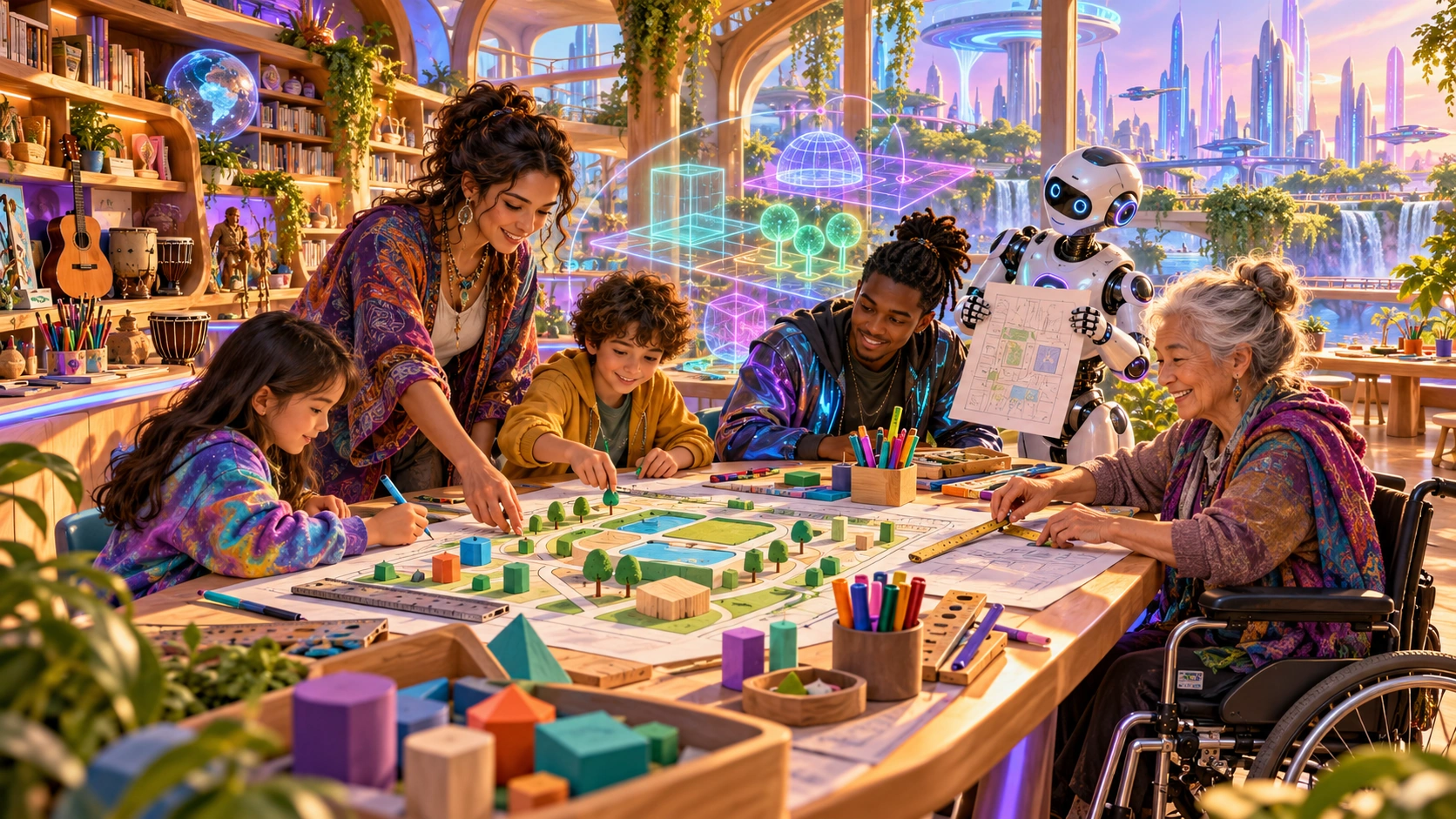
Imagine a session in which a group of children and adults prepares a clear map of a shared workshop. They begin by asking whom it is for. A new participant should be able to find the right workstation and understand the symbols. The group agrees on what needs to be shown.
The teacher explains measurement and scale and prepares a simple example. Participants measure selected distances, convert them, draw a plan and choose descriptions. The tasks match their level of preparation. An AI assistant can suggest a shorter explanation, which the group will assess and check.
The first version goes to someone unfamiliar with the workshop. They try to read the plan and point out unclear areas. Participants compare this feedback with their intentions. They improve the symbols, check the distances and prepare another version.
Afterwards, everyone shows what they have learnt. One person independently converts a new measurement; another explains a chosen symbol. The teacher selects a question to match the skill being learnt. Both the result of the shared work and each participant's understanding become visible.
After the session, a map remains, along with something personal: the ability to measure, calculate, explain or improve an idea. Participants know what they can already do and can choose their next step. This is how New Earth education takes shape through what people do.
What skill would you like to develop — and how will you recognise your own progress?