New Earth Economy and Work
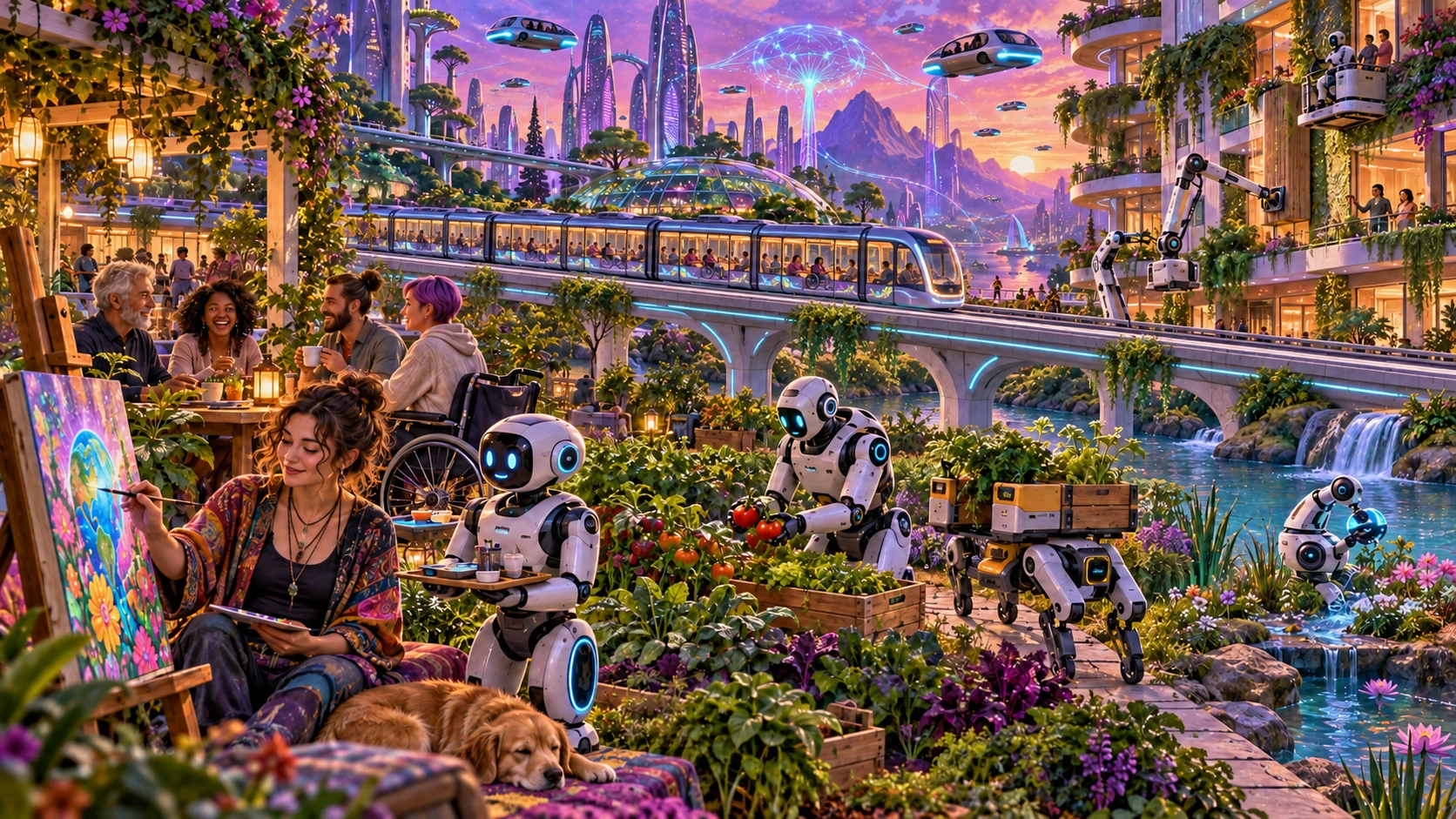
The New Earth economy is intended to give people the conditions for a dignified life. In this vision, AI and robots provide widespread support: they help in homes, produce essential goods, develop services and take part in restoring nature. Their work is intended to free up human time and increase prosperity across society.
This is the direction we propose to build. Different technologies have different capabilities and need to be tested in real conditions. Yet the goal of making AI and robots available throughout every area of life sets a clear purpose: ordinary people should feel the benefits of progress in their own lives.
Prosperity people can feel
Prosperity begins with having a safe place to live, good food, and access to healthcare, learning and transport. People can care for those close to them, rest and develop their own interests. They can plan for the future without the constant fear that one difficult month will take away their basic security.
The economy's achievements should be visible in these conditions. Higher incomes matter when they genuinely allow people to buy more of what they need and use good services. A rise in pay accompanied by equally fast increases in housing and food costs can leave someone in the same position.
Time is part of prosperity too. Someone who spends most of the day working and the rest of the week exhausted has little room to enjoy what they earn. Economic progress should gradually expand people's choices about how much time to devote to work, family, learning, creativity, travel and rest.
Work remains a way of participating in shared life. People can contribute their skills, create things and receive fair pay. Their security should also have a foundation when their previous occupation is no longer needed.
Where homes, food and functioning services come from
Essential goods depend on real resources and systems. Food requires land, water, energy, knowledge, production and deliveries. Housing needs suitable space, materials, construction and maintenance. Healthcare depends on people, equipment, infrastructure and organisation. Money helps put these resources to use, but a payment alone does not immediately create an available home or a medical appointment.
The New Earth economy should connect the understanding of people's needs with the development of the means to meet them. AI can support planning, while robots carry out a growing share of physical tasks. Cooperation between places is also necessary: a region with suitable resources or skills can supply them where they are needed. The terms of that exchange should take account of the people involved in obtaining those resources and producing those goods.
Imagine renovating an existing building. Residents identify their needs: warmer homes, an accessible entrance and reliable utilities. In the intended model, AI helps prepare design options, plan materials and organise the sequence of work. Robots support the team with appropriate tasks, especially those that are heavy, repetitive or dangerous. People make decisions, check safety and accept the completed work.
Such a renovation still needs equipment, skills, energy and funding. Afterwards, the building and its equipment need maintenance. The benefit is assessed in practice: have the homes become more comfortable, has energy use fallen, and do residents feel an improvement? This gives technology a concrete purpose and a measurable result.
Basic security and freedom of choice
The proposed system combines decent pay, income protection and accessible services. People need both money for their own decisions and access to housing, healthcare, education, transport and communications. Accessibility includes price, quality, distance and waiting times.
Some needs can be met through collectively funded services that people use without paying directly. Others may involve charges people can afford or additional support. In every case, costs need to be covered and the arrangements should be clear to the person using the service.
Basic income is one possible tool for providing security. Other benefits and arrangements suited to a particular place can also be considered. When choosing between them, what matters is people's situation after the change: what they actually have left to spend, what expenses they face and whether they retain the help they need. Someone with a disability or a long-term illness may face costs that a uniform payment does not cover.
Basic security should strengthen independence. Access to food, shelter or treatment must not become a reward for obedience, holding particular views or accepting constant surveillance. People should be able to refuse poor working conditions, change occupations and learn without risking the immediate loss of their basic means of living.
AI and robots serve people throughout the economy
In New Earth, help from AI and robots is intended to be available in every field. At home, robots can take over everyday chores; in agriculture, they can support cultivation and harvesting; in factories, they can manufacture essential products; and on building sites, they can help with construction and renovation. Transport, warehouses and municipal services are also part of this shared infrastructure.
In healthcare and care services, technology is intended to support staff, rehabilitation and the independence of people who need assistance. In education and science, AI can help people understand the world, develop skills and carry out research. Robots are also intended to take part in repairing infrastructure, recovering materials and restoring damaged environments. These uses describe the intended direction; the range of tasks entrusted to devices and systems expands as their capabilities are verified.
Widespread availability means access for small towns, lower-income households and people who need support too. It can be developed by equipping public services, creating shared equipment facilities and making solutions accessible to smaller businesses. Using technology should preserve people's choice, privacy and ability to contact a responsible person.
The central economic question is: who receives the benefits of the machines' work? If production requires less human time, some of the gains can go towards shorter working hours, higher pay and more accessible services. Funds are also needed for development, equipment maintenance and reserves. The proportions require clear agreements.
Employee participation in business results, shared ownership, negotiated reductions in working hours and directing some capital income towards shared needs can all help. Technologies can belong to different kinds of owners. The rules governing their use should ensure that improvements in productivity also reach people who do not own factories, robots or AI systems.
Fewer working hours and decent pay
New Earth's long-term direction is a twenty- or twenty-five-hour working week with a substantially higher real standard of living. The ambition is even to double purchasing power: greater access to essential goods, services and leisure from the income people receive. This is a goal of the vision, and its feasibility needs to be assessed in specific conditions.
Widespread help from AI and robots is intended to create room for this change. When machines take over some tasks, the time freed up can be returned to people. This requires agreements on pay and how the work will be funded at the same time. The supply of essential goods also matters, so that rising living costs do not absorb the improvement in income.
A shorter week should bring real relief. Its assessment therefore needs to include overtime, being on call, the pace of work and duties carried out after returning home. A team needs tasks that can be completed within the agreed time.
Services that need to run continuously must have staffing and cover in place. Care, transport and network maintenance also operate while an individual worker rests. Robots, better organisation, shifts and appropriate staffing levels can work together to help maintain that continuity. The pace of reducing working hours will depend on what each field can actually achieve.
Care and a person's value beyond employment
Caring for a child, someone who is ill or an older person takes time, attention and responsibility. This effort sustains life even when it does not appear on a payroll. The organisation of the economy should recognise it.
If one person still carries most of the household and caring duties after a shorter shift at work, the time gained is distributed unequally. Accessible services, someone to step in, respite and a fairer division of responsibility among those close to them are needed.
AI and robots are intended to help here too: with everyday chores, organising assistance and appropriate physical tasks. A well-chosen device can increase the independence of someone who needs support. Time freed up by technology can also be devoted to conversation, closeness and another person's presence.
The right to a dignified life includes people who are ill, have disabilities, are studying or are moving between occupations. Rest and creativity have a place of their own, without an obligation to turn them into a source of income. People may receive help at one stage of life and give it at another. Their value does not depend on how much they produce at a particular moment.
How to fund and maintain shared solutions
An economy based on widespread technological assistance needs systems that someone maintains. Building or buying robots is the beginning. Energy, AI infrastructure, parts, servicing, training and updates remain ongoing needs. Savings in time and materials need to be considered alongside these costs.
In the example of the renovated building, it is necessary to establish who funds the work, who maintains the equipment and how the later benefits are distributed. Lower bills for residents are not automatically money in the account of the organisation that paid for the renovation. Repayment or collective funding arrangements must follow actual agreements.
Tax revenue, contributions, income from shared assets and money redirected from other spending can be combined. Some of the value created with the help of automation can support services everyone uses. A specific programme still needs up-to-date costings, responsible people and sources of funding for the years ahead.
Support needs to be assessed as a whole. The sum of all payments can differ from the programme's additional cost once taxes and changes to benefits are taken into account. At the same time, a saving in the public budget must not conceal costs being shifted onto people who lose essential support.
Both spending and results should be transparent. People need to know what has been funded, who is responsible for running a service and what happens when the outcome differs from the plan. The principles of this accountability are explored in The Political System of the New Earth.
Prosperity within the planet's limits
The New Earth economy is intended to expand access to a good life while using resources responsibly. Durable devices, repairability and well-maintained infrastructure allow people to benefit from work already done for longer. Necessary investments should also be assessed for their use of energy, water and materials, and their effects on the surrounding environment.
AI and robots are also intended to help restore soil, forests and water systems, recover resources and maintain functioning networks and buildings. The devices themselves need materials and energy. Their benefits should be assessed across the whole way they are used, including production, operation and what happens to worn-out equipment afterwards.
Different places need different actions. Where housing, safe water or healthcare infrastructure are lacking, construction and the provision of suitable resources are necessary. In places with high consumption, more effort can go towards durability, modernisation and reducing waste. The shared goal is to improve living conditions while preserving nature's ability to sustain life.
A transition that protects people
Change begins with understanding needs and capabilities. A solution can be introduced on a limited scale in a particular place, with its maintenance secured and its effects assessed. Approaches that work can be extended to other areas, while problems are addressed before the scale increases. This is how widespread help from AI and robots can gradually gain a practical foundation.
Someone whose tasks are taken over by a machine needs income protection, time to learn and an accessible route into another occupation. The change should not require them to bear the entire cost of shared progress alone. This also applies to people who are self-employed and those who have fewer opportunities to retrain.
As technology develops, people should increasingly be able to choose occupations suited to their skills and interests. The essential duties that remain require fair pay, good conditions and a reasonable division of work. It is also necessary to check whether difficult work has simply been moved to a less visible part of the economy or another region.
Changes can be assessed through a few straightforward questions. Have essential services become more accessible, and have waiting times fallen? Have quality, safety and continuity been maintained? Has the combined burden of paid work and care decreased, leaving more time for rest? Has income after living costs improved, and do shared solutions have sustainable funding? Has resource waste fallen, and has the environment improved?
The answers also need to be checked for people and groups whose circumstances may differ from the average. Five years can set the horizon for an ambitious programme of action, but it does not guarantee universal prosperity within that time. The direction becomes more credible with each result that can be seen in people's lives.
In this vision, robots and AI work throughout the economy, and people gain more room to live. The measure of success remains close to home: a safe place to live, accessible help, lighter responsibilities and time people can use as they choose.
What single measurable result would show that economic progress had genuinely improved life for people around you?