New Earth Businesses
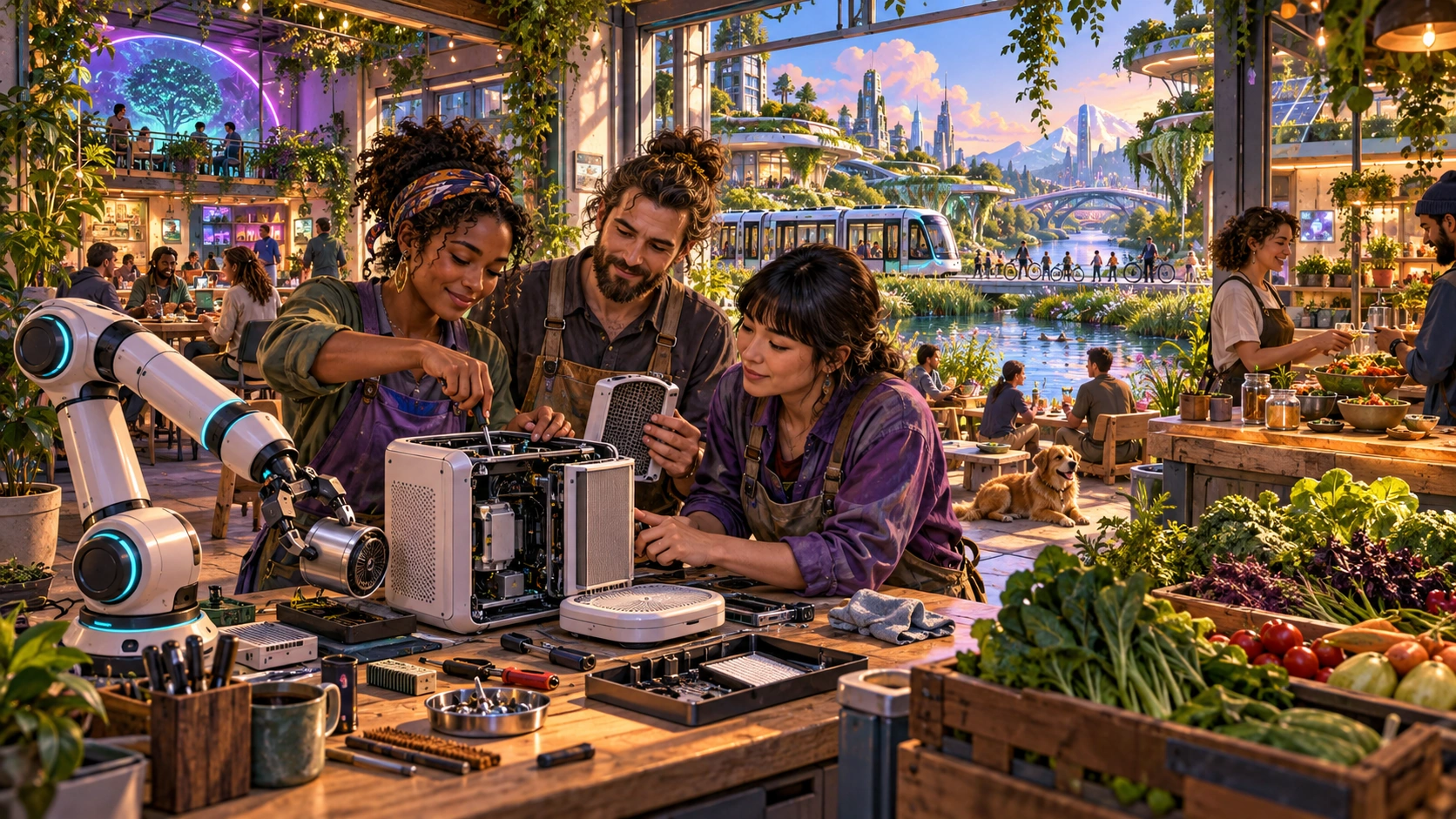
We create businesses that meet real needs, respect people's work and help build prosperity that is accessible to everyone.
A useful purpose for a business
Every day, a vast number of people devote their time, knowledge and energy to work. These resources produce homes, devices, food, roads, services and technologies. It is worth asking where this shared effort leads. Does it help us live better, or are we working more and more simply to stay afloat?
A New Earth business begins with a useful purpose. It provides something people need, does so reliably and can explain the effects of its activities. It respects the people who work for it, use its products and live around it.
It might be a small workshop, a farm, a shop, a studio, a transport company or a large manufacturer. Its direction is determined by its products, working conditions and decisions. We do not have to belong to one organisation or use our spiritual language to create something consistent with New Earth's values.
Profit helps sustain a business, pay for work and develop solutions. In a well-run company, it also provides security for difficult times. We also assess the whole enterprise by whether people and their surroundings actually benefit from its success.
Work without exploiting people's dependence
Someone who has to pay for housing, buy food and support a family often cannot simply leave their job. A lack of savings, few local vacancies, caring responsibilities or the cost of commuting can narrow their choices. A signed contract can therefore coexist with a very unequal position between the two parties.
An employer may exploit this dependence by offering pay that barely covers basic needs, pressing for more overtime or discouraging people from reporting problems. The threat that someone else could take your place is especially painful when you cannot see a safe alternative. We do not justify such practices by the need to increase profit.
Pressure can also affect a person's sense of self-worth. Someone who is constantly told to be grateful for any employment may gradually stop believing they have the right to expect respect and fair pay. Rebuilding that inner foundation matters. At the same time, someone who knows their worth can also find themselves without a good way out. Responsibility for exploiting dependence lies with the person who exploits it.
A New Earth business creates conditions in which refusing extra work, reporting a hazard or discussing pay does not lead to humiliation. It clearly explains duties, working hours, pay and opportunities for development. It honours agreements and pays for the work performed.
The state also has responsibilities. It fails people when it tolerates violations of their rights, leaves them without effective protection or gives public support to businesses without checking how they treat workers. We need institutions that strengthen decent pay, the ability to negotiate working conditions collectively and a real chance to change jobs. Let us assess specific decisions and their effects. Our expectations of business and government can be firm while still leading towards better solutions.
More opportunities and fewer hours of work driven by necessity
Development should also be felt in the life of someone who helps create a company's results. If a business operates more effectively, workers should have a chance to benefit through higher pay, shorter working hours, a share of the gains or better conditions.
In our vision, we move towards twenty or twenty-five hours of work a week, with an income that allows people to live without constant financial anxiety. Our ambitious aim is a substantial increase in real purchasing power, potentially even doubling it in a more developed version of this vision. What matters is how much housing, food, rest and other necessities that income can actually provide. A larger figure on a payslip changes little if prices rise just as quickly.
Achieving this direction requires productivity, available goods and a deliberate sharing of the benefits. A company needs to know how it will cover wages and costs with shorter working hours. The situation differs between automated manufacturing, care work and transport. Preparation, suitable teams and checking the results are all necessary.
We do not shorten the working week by squeezing the same overload into fewer hours. We improve tasks, reduce unnecessary procedures and use technology that actually helps. Where services need to continue, we organise shifts so that people have time to rest.
Fear of losing a job is understandable. A robot may replace a task, while the person still needs an income. Technological change should therefore also include training, support during the transition and an agreement about who receives the benefits of automation. The system will not ensure a fair distribution on its own. We have to organise it deliberately.
Work will still be necessary. Increasingly, however, people can choose what they are good at and enjoy, develop new skills and change direction without fearing for their basic living conditions. The time they regain makes room for family, creativity, learning, travel and simply being at peace.
Ownership and a say in shared work
There are different ways to organise a business. We can develop a private company, a cooperative, an employee-owned business or a structure that protects its chosen purpose. Each of these forms needs transparent rules and responsible management.
An owner can retain their role while giving workers a real voice. Consulting people about changes, establishing clear rules for sharing profits and allowing problems to be reported matter when they influence decisions. A discussion that only appears meaningful, followed by the same outcome every time, does not build trust.
In a cooperative, members jointly control the enterprise and decide how to use its surplus. They may allocate funds to development, reserves and purposes agreed by the community. Membership also involves responsibility for how the business operates.
Honest information is needed about who makes decisions, who owns what, how work is paid and how benefits are shared. This clarity helps people cooperate even when disagreements or more difficult periods arise.
Earning income through durability and good service
An object can be designed to work for a long time, be repaired and develop alongside its user's needs. A good business can earn income by making that object, servicing it, upgrading it or preparing it for use again.
A workshop can replace a worn component instead of encouraging someone to buy a whole new device. A manufacturer can provide spare parts and repair instructions. A studio can restore furniture, while an equipment provider can make a tool available to someone who needs it only a few times a year. Each of these services creates value that people can pay for fairly.
The price should cover work, materials, quality, customer service and responsibility for the result. Fairness does not mean that an owner or worker must endlessly subsidise the business at their own expense. We need models that can support people without pressuring customers into unnecessary purchases.
Rental also requires good design. Durable equipment, sensible logistics, maintenance and a clear agreement can improve access to things. Frequently transporting poor-quality products and encouraging constant replacement may instead waste the expected benefits. We examine how the service actually operates.
Customers should know what they are paying for and what they can cancel. Access to repairs, their own data or a device's basic functions should not become a tool for making them indefinitely dependent on further payments.
Existing companies show different parts of this direction
Fairphone shows the possibility of developing electronics with repair and longer use in mind. In its own materials, it also describes measures relating to working conditions at suppliers, including wage bonuses in selected factories. These are examples of specific practices whose scope can be checked. A bonus programme alone does not mean that the entire supply chain has already achieved decent pay.
Patagonia has adopted an ownership structure in which the Patagonia Purpose Trust protects the company's purpose through voting rights, while the Holdfast Collective receives surplus profits after reinvestment for environmental activities. The company continues to operate commercially. This example shows how ownership can help preserve a mission beyond an individual founder's declaration.
MONDRAGON presents a model of cooperation between cooperatives, members' participation in management and wage solidarity. We can examine how working people participate in decisions and business development. We do not assume that every employee throughout the group has the same membership status.
We do not award these organisations a title of perfection. Each illustrates a different mechanism, and their own descriptions need to be kept in context. We can learn from specific solutions while retaining the right to ask questions and assess their effects.
Food that nourishes people and deserves their trust
One useful New Earth business could be a shop working with reliable food producers. It offers vegetables, fruit, pulses, wholegrain products and other ingredients that make varied meals possible. It takes care of freshness, storage, information about origin and prices that are also accessible to people on lower incomes.
We can develop local food processors, kitchens and bakeries that make nutritious products with clear ingredient information, limit excess sugar and salt and provide reliable allergen information. Cooperation with farms helps plan deliveries and reduce food waste. Revenue comes from selling food people need, while quality also includes fair payment to producers.
The everyday phrase 'chemical-free' is better translated into something we can check: safety, monitoring contaminants and residues, nutritional value and honest ingredient information. All food consists of chemical substances. A long ingredient name does not by itself determine whether it is harmful, just as the word 'natural' does not guarantee safety.
From older ways of making food, we can preserve skilled craftsmanship, seasonality, flavour and respect for ingredients. We combine them with current knowledge of hygiene, storage and quality. Returning to good practices should serve people's health, so we also examine those practices using today's methods.
Accessibility matters. Good food should not become a luxury label that earns money by frightening people about everything in an ordinary shop. We develop products people can trust and actually afford.
Examples of New Earth businesses
There are many more possibilities. The following directions are proposals for businesses that should be adapted to actual needs, skills and conditions.
A nature restoration team could help restore appropriate water conditions, regenerate soil and protect habitats. It works with qualified specialists and landowners. It earns income from well-executed projects and their maintenance, assessing results by the condition of the environment rather than the number of impressive planting photographs.
A robotics company could create devices for dangerous, heavy or repetitive tasks. It offers implementation, training, maintenance and equipment development. It agrees with workers on how their jobs will change. The quality of a solution includes safety, usefulness and how the time regained is used.
A local production workshop could make spare parts, tools and equipment suited to people's needs. It combines human skills with design and machinery. It earns income from making and maintaining useful things, taking account of safety and rights to the designs.
A housing business could build or modernise comfortable homes with reasonable running costs. Its offering includes construction quality, energy efficiency and ongoing maintenance. We also assess its purpose by whether it helps improve access to housing rather than earning money solely from its inaccessibility.
A transport operator could develop bus and rail connections, shared journeys and services to workplaces. Several people travelling together need convenient timetables, reliability and affordable fares. The model might use tickets, agreements with employers or agreed funding for public services. Planning is based on passengers' actual routes and needs.
A learning workshop could offer practical classes in repair, gardening, programming, crafts or using new devices. People developing a passion can teach others and receive fair pay. Participants' safety, instructors' competence and accessible classes remain part of the quality of the service.
An amusement park, sports space, music venue or holiday centre can create joy, opportunities to meet and rest. These are useful needs too. Income can come from events, tickets, classes and services. Good working conditions for staff, safety and care for the surroundings should develop alongside the offering.
Not every passion has to become a business. We can, however, build conditions in which someone with a skill and a good idea can find customers without giving up their own life.
Five years of shared effort towards prosperity
Imagine directing a much larger share of our productive capacity, knowledge and money towards restoring life to the planet, durable homes, useful robots, good food and accessible transport. Companies cooperate, share useful skills and solve problems that currently take away people's time and security.
In this vision, five years of determined, shared action could bring an enormous increase in prosperity. It is an ambitious horizon whose realisation depends on the scale of cooperation, infrastructure, materials, energy and the quality of decisions. No single machine or policy can ensure this result for the whole planet.
We can give this effort a direction. First, identify the most urgent needs and test solutions on a small scale. Then develop those that work, train people and establish support for production and maintenance. In subsequent stages, connect good solutions into accessible networks and check whether their benefits actually reach residents.
Breaking out of autopilot also begins within a company. We can ask whether the next order repeats a harmful product or unnecessary waste, or helps solve a real problem. A business can gradually change its offering, technology and ways of working. Chemical technology can also serve health, water and useful materials; we assess each application and its effects.
Ultimately, everyone should have access to a safe home, good food, care, transport and rest. Holidays, developing interests and enjoying life can become ordinary parts of prosperity. As we pursue this vision, we take care both of producing useful goods and of the rules governing access to them.
Checking the results of a business
A company shows its direction through results. Does the promised repair work? Have people received the agreed pay? Is the product safe? Can a customer report a problem? Does the company take responsibility for waste and conditions at its suppliers?
A mission needs scrutiny and the possibility of improvement. When a mistake occurs, an honest business recognises it, informs the people who need to know and takes steps to put it right. A good intention does not remove the effects of something done badly.
A small project can begin with a few specific questions. Who do we want to help? What service or object will we provide? How will we check that someone needs it? What are the costs of work, materials, maintenance and safety? What will we count as a good result?
Then we carry out a small trial. A workshop checks a few repairs and their actual cost. A rental business observes how tools are used and how they wear. A food producer tests demand, quality and delivery arrangements. On that basis, the idea can be developed, changed or the trial brought to an end.
New Earth businesses can emerge through new ventures and the transformation of existing companies. The shared direction remains clear: useful solutions, fair work, responsible technology and benefits people can feel in their lives. The more activities we organise in this way, the more of our shared energy goes towards a world in which we can truly live well.