Meditation
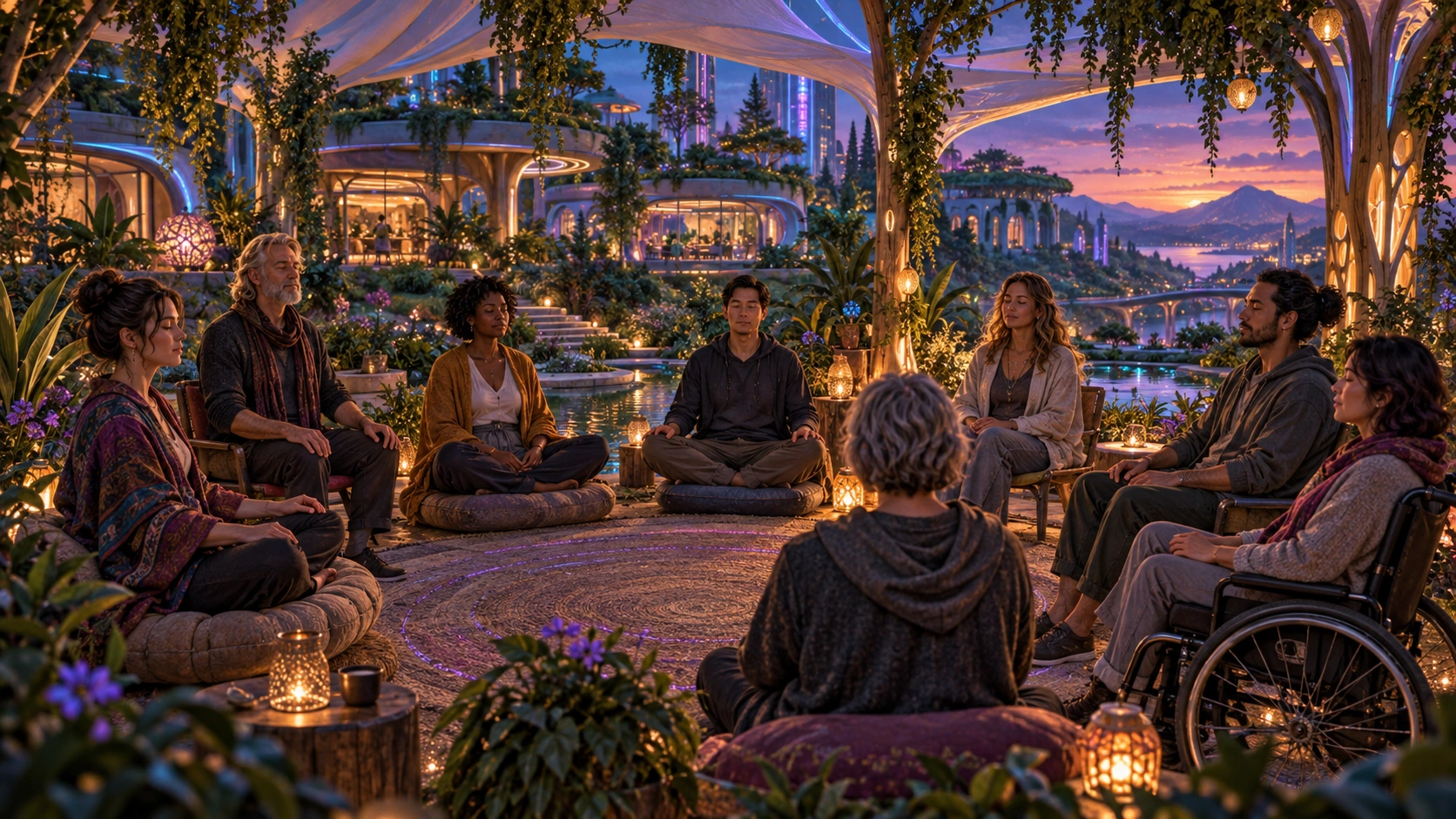
Practising presence and coming together in the New Earth.
Coming together in silence
Imagine a late afternoon in the New Earth. In a garden, beneath a light canopy, people are slowly taking their places. There are cushions, chairs and a wide passage. Someone arrives after work, someone comes from a neighbouring house, and someone is here for the first time. The host welcomes everyone and explains how long the gathering will last. Soon the conversations grow quiet. You can hear leaves moving in the wind.
In our vision of the New Earth, the community's spiritual life centres on open meditation gatherings. These take the place of church services. People come together to spend time in presence, explore their inner life and direct a shared intention towards peace, love and care for life.
Everyone brings their own story to the circle. One person finds a deep sense of connection in the silence. Another mainly notices how tired they are after the day. Both can be here. The gathering leaves room for what we actually experience.
We can begin creating such a space on a small scale. It needs people who can agree on the arrangements, look after the place and welcome those who arrive with kindness. Individual meditation helps us get to know the practice at our own pace. A shared gathering gives it a place in the life of a community.
What meditation is
Meditation includes different practices. Some develop concentration, others mindfulness, contemplation or spiritual self-exploration. Different traditions give them their own meaning. Here we will begin with a simple practice of directing attention towards present experience: breathing, sounds and what we notice within ourselves.
In the rush of daily life, attention can easily move between what has happened and what might happen next. During meditation, you set aside a little time to notice that movement. You recognise where you are now and return to your chosen focus.
Thoughts may still arise. You might hear a noise, feel impatient or remember something you have not finished. The practice offers an opportunity to observe how attention wanders and how you direct it again. Calm may arise, but you do not have to force it in order to try this practice.
Meditation has its own dedicated time. Mindfulness can also accompany an ordinary activity. When you really listen to someone's words or notice your surroundings on a walk, you are also paying attention to present experience. You can practise both forms, keeping a simple connection between them.
Preparing for your first practice
Choose a short amount of time that you can give yourself now. Find a place where you can sit quietly. An ordinary chair is enough to start with. Position your body so that it has comfortable support. Your hands can rest on your thighs or in another relaxed position.
Adapt the position to your own needs and abilities. You can support your back, adjust your feet or use a cushion. Leave yourself room to move if you need to. Your eyes can be closed or open, with your gaze resting on a quiet part of your surroundings.
Notice your natural breathing wherever you can easily feel it. This might be the gentle movement of your abdomen or the flow of air near your nose. Allow it to keep its own rhythm. In this practice, you do not need to lengthen it, hold it or breathe more forcefully.
If you prefer another focus, choose the sounds you can hear. Notice them appearing and fading, even when they are ordinary: street noise, footsteps or a device running. You do not have to prepare a perfectly silent world. It is enough to find conditions that suit you for this short attempt.
When attention wanders
You sit for a moment, notice your breathing, and then realise that you have been planning tomorrow's conversation for some time. You are preparing replies, anticipating reactions and have almost forgotten where you are. That moment of recognition is an opportunity to return.
Simply notice: planning has taken up my attention. Then direct your attention back to your breathing or to sounds. Do this as ordinarily as you return to a page you are reading after looking out of the window. You may return many times during one short practice.
Approach emotions in a similar way. Impatience, sadness or anger may be present while you sit. Give yourself room to notice them without immediately resolving the whole situation. If they concern a real problem, you can attend to it after the practice or end the practice earlier.
Over time, you may recognise the moment when attention starts to wander. Today you might notice it after a longer interval, and another time sooner. Each attempt brings its own experience. You do not have to judge your worth or spiritual development by the number of distractions.
A first attempt of about five minutes
Read the whole instruction first. Then, if you would like to, put the text aside and try it at your own pace. You can set a gentle signal for the end or choose a shorter time. Five minutes is a suggested amount of time to give to the practice.
Sit comfortably. For the first few moments, notice where you are. Look at your surroundings and check whether the position suits you. Adjust it if you need to. Choose whether to keep your eyes open or close them.
Next, direct your attention towards your natural breathing or towards sounds. Stay with your chosen experience for a little while. You might notice differences between successive breaths or hear something that escaped your attention before. You do not have to find anything special in it.
When you notice that a stream of thoughts has occupied your attention, recognise this and return. If your attention wanders again a moment later, choose your focus once more. Repeat this simple movement as many times as you need, without rushing.
Towards the end, look around you. Move a hand, adjust your position and finish when you are ready. You can notice how you feel now, even if very little has changed. At any point, you were free to shorten the attempt, change your focus or stop.
The spiritual dimension of meditation
From the spiritual perspective of the New Earth, meditation is also a space for encountering a deeper dimension of life. Silence may open up an experience of connection with ourselves, with other people and with what we call the Source. We use these words to describe a way of understanding experience, leaving room for its mystery.
Sometimes, when you pause, you hear something more clearly that had been lost in the rush: a need for rest, an intuition about a choice, a sense of closeness to life. You can give it attention. When an important decision arises, it is worth exploring intuition alongside the facts and the possible consequences of taking action.
An intention can be a simple direction you bring to the practice: presence, peace, love or care. You do not have to compose elaborate statements or create a complete image of the future. You can spend a moment with a quality you want to invite into your way of being.
Everyone has their own language for this path. Someone speaks of consciousness, someone of God, someone of nature or closeness. You can also meditate without giving it a religious meaning. The shared space remains open to these differences. Special images, visions and sensations are not a condition of taking part.
Shared meditation in the New Earth
Shared meditation has a regular place in the life of a community in our vision. People know they can come, meet others and set aside time for presence. A rhythm develops that connects personal practice with the experience of being together.
We propose this form of communal spiritual life in place of church rituals. The gathering rests on direct participation, exploring ourselves independently and choosing a shared direction. We give up imposing dogmas, frightening people with spiritual punishment and granting anyone power over another person's conscience.
The place could be a garden, a neighbourhood room or a space prepared specifically for quiet practice. It should be accessible to people with different abilities. It is worth providing chairs, a comfortable temperature, an open passage and a way to leave quietly. The community also takes responsibility for these ordinary conditions.
The arrangements need a host and someone who can clearly explain the practice. Their role is specific: to welcome participants, describe the process, keep to the agreed time and answer questions. The person leading the practice remains someone who can be asked for an explanation or disagreed with.
A participant's spiritual worth is not for the person leading the practice to assess. Everyone keeps their own beliefs, religion and right to decline. Believers, non-believers and those who are searching can meet in the circle. Someone who prefers another practice or does not want to come still has an equal place in the community.
In our spiritual vision, shared attention and intention can be understood as helping to create the field of the New Earth. This perspective matters to us, but taking part does not require accepting that explanation. You can simply sit beside others and explore your own experience.
A shared intention might concern peace, respect for life or care for the place where we live. What it becomes also depends on how we behave outside the gathering. Meditation offers no guarantee that it will remove conflicts or resolve other people's suffering on its own. It remains a space for exploration and choosing our own contribution.
What a shared gathering could look like
Let us imagine a gathering lasting about twenty minutes, after which people can stay for a conversation. Information about it gives the location, time, accessibility and way to take part in advance. The host makes sure someone arriving for the first time can easily find the entrance and ask a question.
At the beginning, the host welcomes participants. They explain how long the practice will last and how it will end. They explain that people can sit on a chair, change position, keep their eyes open and leave whenever they need to. These choices are an ordinary part of the gathering.
Then come a few simple instructions. Everyone finds a comfortable position and chooses their own focus. We do not have to breathe in the same rhythm or adopt the same posture. The person leading the practice allows time for people to find what suits them.
Shared silence follows. Sometimes someone moves, a breath can be heard or a sound comes from outside. You can notice these things and return to your own practice. We do not watch others in order to compare who looks more focused.
Before the end, the person leading the practice can invite those who wish to join in a shared intention. For example, to dedicate this moment to peace and care for life. Everyone chooses whether to accept the invitation and what meaning to give it. You can also simply remain in silence.
An agreed signal marks the end of the practice. People return to their surroundings at their own pace. Someone stretches their arms; someone stays seated for a little longer. Then the host reminds everyone that they can stay for a conversation or finish their participation.
Conversation is an option, not an obligation. You can ask about posture, describe a difficulty or share something important. Someone who listens and says nothing about their inner life also takes part fully. A person's experience does not become material for judging them or persuading them to adopt our interpretation.
The gathering respects privacy. Taking part does not imply consent to recording, photography or touch. The host also looks after tidying the space and making clear arrangements for its upkeep. In this way, shared meditation takes a simple, repeatable form, with care for people and the place.
Difficulties and your own pace
During practice, you may feel bored, sleepy, uncomfortable or impatient. Notice what you need at that particular moment. Sometimes it is enough to adjust your position or shorten the time. At other times, it is better to finish and return to ordinary rest.
It is also worth noticing an expectation that meditation should immediately produce a clear result. If you judge every moment in that way, the practice itself may become another demand. You can allow yourself a short experience that you do not have to reach a conclusion about yet.
Meditation is not right for everyone. If it intensifies anxiety or distress, or makes you feel worse, stop the practice and seek support suited to your situation. It does not replace necessary healthcare. Ending an attempt does not indicate a lack of maturity or lesser spiritual worth.
The same principles apply to everyone at a shared gathering. The person leading it should respect someone's departure without demanding explanations. You can say what you need afterwards, but you do not have to justify your comfort to the whole circle. Your own pace belongs to you.
Presence after meditation
After the gathering, we return to conversations, work and daily responsibilities. You may notice that, for a little while, listening comes more easily. You may also still feel tired or distracted. Give yourself room to see what actually happens after the practice.
Imagine that, as you leave the garden, someone begins telling you something. You notice that you are already preparing your reply, even though they are still speaking. You can direct your attention towards their words again. This simple return resembles the movement you were practising in silence a moment earlier.
In the circle, people sat beside one another while keeping their own inner life. Afterwards, the possibility of an attentive encounter remains: letting someone finish, hearing a question, noticing a difference. Community continues in these ordinary moments too.
Meditation can have a place in your life if you choose to return to it. You decide its time, form and meaning. In our vision of the New Earth, shared places of silence help give this path space among people. We come with our own experience, spend some time together, and then return to life.