Restoring Nature in New Earth
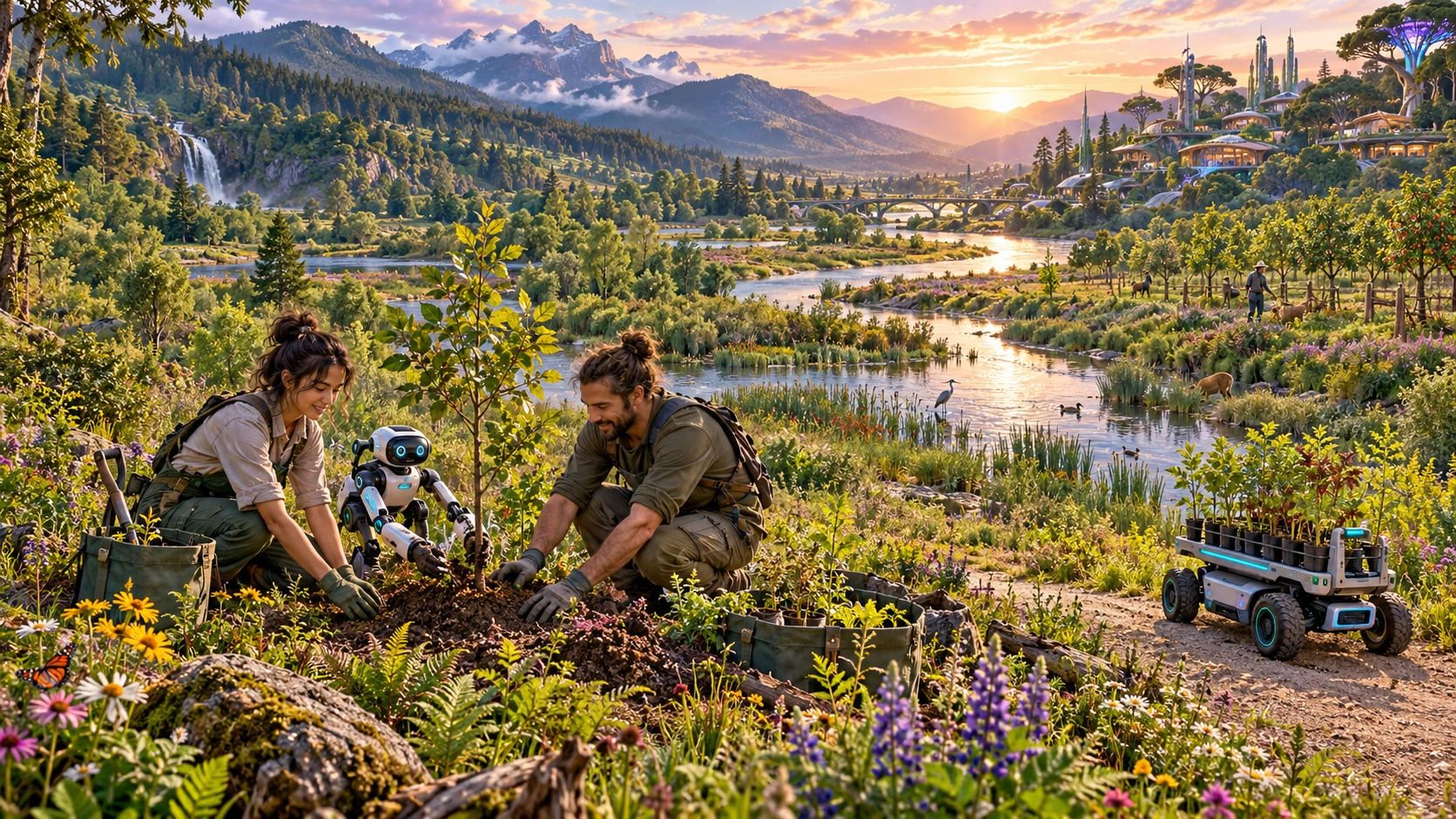
In New Earth, nature's recovery is part of everyday life. The landscape has room for healthy forests, flowering meadows, fertile soil and water. People have access to beautiful surroundings, and animals to habitats where they can live. The development of communities, farms and technology takes this shared space into account.
We treat restoring the planet as one of the main focuses of our effort. We direct knowledge, work, resources and production capacity towards it. In this vision, AI and robots are widespread helpers: they support the assessment of needs, carry out suitable physical tasks and help monitor the results. With their help, we can expand the scale of our work and lighten people's workload.
This is a picture of a future we propose to build. We already know many ways to protect nature and help it regenerate. Other solutions, particularly greater autonomy for machines in changing terrain, need further development. We combine the possibilities of technology with knowledge of each place and the life that is to return to it.
We protect the nature that remains
An existing forest, wetland or well-preserved soil has a value we take into account in every new development. We protect places that sustain life and help damaged ones recover. Protection and restoration can progress together across the landscape.
We begin by identifying the cause of the damage. Soil may be washing off an exposed slope, water may be draining away too quickly, or pollution may be arriving continuously from elsewhere. Planting alone will not solve the problem if its cause remains. We need to know what must change so that subsequent work has a chance to last.
Field observations, the history of a place and the experience of people who have known it for years all help. A farmer remembers where water flowed during a downpour. Residents notice a wetland pool disappearing. A naturalist recognises the habitat and the organisms still living there. Sensor data and maps can add to this knowledge.
On this basis, we choose a goal. In one place, it will be protecting natural regeneration; in another, restoring water conditions; and in a third, removing contamination and preparing the land to recover. The work responds to the needs of the particular ecosystem and the people living around it.
We bring life back to the soil
Soil is a home for roots, microorganisms and small animals. Its structure, organic matter and use influence growing conditions for plants and the water cycle. Restoring this life matters both for nature and for food production.
We can protect the ground with vegetation or suitable cover, maintain organic matter and grow a variety of crops. We reduce unnecessary vehicle movements and loads that compact the soil. Our choice of practices takes account of soil type, moisture, climate and land use.
Appropriate action also requires identifying contamination. Land affected by industry may need different measures from a field depleted by years of cultivation. Recovered organic material should be of a quality suitable for its intended use. We base restoration on the actual condition of the place.
In the vision of New Earth, AI helps bring observations together and detect changes, while lightweight robots support measurements and precise work. They can ease the work of distributing suitable materials, tending plants or maintaining designated areas. Their weight and movement also need to suit the ground they are meant to help.
We make room for water in the landscape
Water connects fields, forests, wetlands and communities. The area from which it drains into a shared watercourse or body of water forms a catchment. That is why it is worth considering the condition of a stream alongside what happens upstream: on slopes, roads, farms and developed land.
We help restore rivers' connections with suitable floodplains, the condition of their banks and wetland habitats. Where a peatland has been damaged by drainage, restoring appropriate water conditions is an important direction. Each place needs its own assessment and plan.
Changing water flow requires considering neighbouring land, buildings and the needs of people and nature. Teams responsible for water work with residents and landowners. They agree on the scope of work, maintenance and monitoring of the effects, including those beyond the immediate site of intervention.
Sensors can help track water levels and quality, AI can detect concerning changes, and suitable equipment can support work and inspections. A stream's appearance provides only part of the information. Clarity alone is not enough to consider water safe; appropriate testing also tells us about its quality.
Forests and meadows regain their diversity
In some places, nature already has the resources it needs to recover: young plants, seeds and a surviving habitat nearby. Help may involve reducing pressures, protecting regrowth and removing specific obstacles. We then leave room for processes that have already begun.
Where the potential for natural regeneration is too limited, additional planting or other measures may be needed. We choose species and planting material suited to the habitat and its future conditions. Subsequent care and monitoring of plant survival are part of the same work.
When restoring a forest, we consider different species, layers of vegetation and stages of development. Meadows, grasslands and scrub also have their own inhabitants and value. Preserving an open habitat may be the appropriate goal. We choose how to maintain it according to the needs of the life found there.
In New Earth, robots help in nurseries, transport young plants and carry out selected field tasks. Aerial observation can make it easier to identify changes over a larger area. We plan the use of equipment so that the help itself does not unnecessarily damage vegetation or disturb wildlife.
Safe space for people and wildlife
Wild animals need food, shelter, breeding sites and ways to move between habitats. We take these needs into account when planning the landscape. We also care for pollinators and less noticeable organisms that contribute to its diversity.
At the same time, people have a right to safety. The presence of predators in a region calls for measures that protect residents, people working outdoors and those using trails. Suitable habitats, wildlife crossings, measures to secure residential areas and prepared response teams can work together to reduce dangerous encounters.
In this vision, we develop monitoring for animals that may pose a threat. Selected individuals receive tracking devices when their species, health, age and size allow it. This includes young animals where tagging is appropriate for them. Specialists choose the equipment, account for the animal's growth and provide monitoring and a way for the device to detach safely.
GPS works alongside other forms of observation. Cameras and sensors at suitable locations can also help detect untagged animals, while AI can organise reports and flag events that need checking. The system is intended to protect people and animals while disturbing their lives as little as possible.
Residents have access to a simple app showing warning zones, areas of recent confirmed sightings and the time of the latest update. A notification may appear when an animal approaches a residential area or a busy route. People without the app can use text messages, local announcements and accessible contact with response services.
We make the precise current coordinates of sensitive species available to authorised teams. Public warnings should help people avoid danger while protecting animals from poaching and harassment. The map also indicates when recent data is unavailable. An empty screen is no assurance that there is no animal nearby.
A warning must be backed by the ability to act. Trained teams check alerts, help residents and choose an appropriate response. Any relocation of an animal is preceded by an assessment of living conditions and the effects on the destination. Combining habitat care, technology and effective assistance gives this vision practical meaning.
We produce food together with nature
Farms are part of a landscape through which water flows and organisms move. The way crops are grown also affects the surroundings of fields. That is why we develop food production together with the protection of soil, water and necessary habitats.
Crop diversity, appropriate cover, strips of vegetation and adapted agroforestry systems can help combine these goals. Agroforestry means integrating trees into a farming system. The arrangement must suit the farm's conditions, the needs of the plants and the capabilities of the people who will look after it.
Farmers take part in choosing solutions and assessing how they work. They need knowledge, equipment and conditions that allow them to sustain changes over the years. Introducing new practices should take account of yields, workload and actual effects on soil and water.
AI and robots help observe crops, identify plants' needs and perform suitable tasks. In this future, they can support precise resource management, crop care and harvesting. A solution's usefulness is demonstrated by how it works on a particular farm, together with its maintenance costs and effects on the surroundings.
We restore life in the seas and along the coasts
Protecting the sea also begins on land: at sources of pollution, in water systems and in river basins. We reduce the inflow of waste and harmful substances while working on the condition of coastal and marine habitats.
Different regions require different measures. In one, mangroves and appropriate water exchange are important; in another, coastal wetlands, seagrass meadows or reefs. Assessing a place includes its environmental conditions, the organisms present and the needs of coastal communities.
Technology can support observation, sampling and carefully chosen ways of removing waste. In our vision, specialised robots also help underwater and in places difficult for people to reach. Their work takes account of the safety of organisms, how material is collected and the ability to check the effects.
The measure of restoration is an improvement in living conditions in the particular habitat. The number of bags collected or plants put in describes part of the effort. Afterwards, we need to see whether the source of damage has been reduced, the plants survive and organisms have conditions for further development.
We live close to living nature
In New Earth's communities, greenery, water and buildings form a thoughtfully planned whole. Trees provide shade, suitable surfaces allow water to soak in, and connected patches of vegetation provide space for different organisms. People can rest close to home and watch the seasons change.
These surroundings should be accessible across different neighbourhoods and communities. The design considers convenient routes, the needs of people with limited mobility and the ability to enjoy the space peacefully. Some areas serve everyday gatherings, while other parts are used less intensively by people.
Greenery also needs room below the surface: suitable conditions for roots and water. Planning takes account of existing infrastructure, subsequent care and how plants will develop. Residents can help identify needs and report problems.
Robots support suitable maintenance tasks, while sensors and AI help detect the need for intervention. We also direct technology towards preserving mature vegetation and making room for nature again. The result is demonstrated by surroundings that people and other organisms can enjoy for years.
AI and robots help bring life back
Widespread technological assistance connects all these areas. AI can bring together maps, measurements and field observations, help identify species and compare changes. Drones and other devices supply data from places that are difficult to reach. Such applications are already being developed in research and nature conservation.
In the New Earth we envisage, we extend this help to many physical tasks: running nurseries, transporting plants, appropriate planting, care and waste removal. Many devices can work together on a long-term project. Making this assistance widespread is a direction for development; individual tasks require equipment prepared for real conditions.
Nature's needs determine the scope of technology's use. In one place, regular moisture measurements will be useful; in another, less frequent observation and reduced vehicle access will be enough. People set goals, draw on specialist knowledge and adjust the work when unwanted effects appear.
A robot helping with restoration also needs energy, materials and servicing. We take these requirements and the disturbance caused by its work into account. We develop solutions whose assistance produces a justified result in relation to the resources used. Technology is intended to expand our ability to care for the living world.
One valley shows the direction of a larger change
Imagine a small valley. After heavy rain, soil washes from some fields into the watercourse. Part of a former wetland has dried out, and strips of vegetation are disconnected. Residents want to improve the condition of the place while keeping farms viable and homes safe.
They begin together with farmers and specialists. They inspect the land, gather information on water flow and identify surviving habitats. AI helps bring the observations together on a map. A picture emerges of the connections between slopes, fields, the watercourse and buildings. It then becomes easier to establish which measures may help and who will feel their effects.
They choose suitable places for soil protection, vegetation restoration and improvements to water conditions. They agree on the scope of work, access to land and subsequent care. Robots help transport material, perform selected tasks and take measurements. Some parts of the land receive active help, while others receive the conditions needed for natural regeneration.
After the first works are completed, they return in subsequent seasons. They check soil condition, water conditions, the persistence of vegetation and the presence of selected groups of organisms. They compare observations made using similar methods and at appropriate times. They account for weather and other changes in the surroundings to better understand the result.
When plants fail to establish in one place, they look for the cause and adjust the work. When a solution makes farming harder or causes a problem farther down the valley, they revisit their shared agreements. Restoration continues alongside care for its effects. Participants know what has been done, what has changed and what still needs attention.
This is our example of a possible approach. Proven solutions can be developed in further catchments, connected across larger areas and adapted to other conditions. The pace of restoration depends on the place, the scale of damage and the ability to sustain the work. Successive seasons show how the chosen direction becomes a living landscape.
Prosperity in New Earth includes the opportunity to live in surroundings that are recovering. The shade of a roadside tree, water in a place where suitable conditions have been restored, diverse plants and safe space for people and animals. Our knowledge and technology can work towards such results every day.
Which place near you could use help to come back to life?